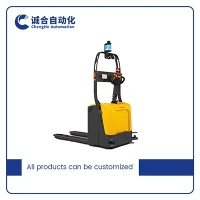
Hey there! As a supplier of AGV Multi Vehicle Linkage, I'm super stoked to dive into the technologies involved in this awesome field. AGV, which stands for Automated Guided Vehicle, has been revolutionizing industries with its ability to move materials around efficiently and autonomously. And when we talk about multi - vehicle linkage, it takes things to a whole new level.
Navigation Technologies
One of the most crucial aspects of AGV multi - vehicle linkage is navigation. There are several methods that AGVs use to find their way around.
Laser Navigation
Laser navigation is a popular choice. AGVs equipped with laser scanners emit laser beams and measure the time it takes for the beams to bounce back from reflectors placed around the environment. By analyzing these reflections, the AGV can calculate its position accurately. This technology allows for high - precision navigation, making it ideal for environments where accuracy is key, like in a precision manufacturing plant.
Vision Navigation
Vision navigation is another cool option. AGVs use cameras to capture images of their surroundings. These images are then processed using computer vision algorithms to identify landmarks, paths, and obstacles. Vision navigation is great because it can adapt to changing environments more easily than some other methods. For example, if there are temporary obstacles in the path, the AGV can quickly adjust its route.
Inertial Navigation
Inertial navigation relies on sensors such as accelerometers and gyroscopes. These sensors measure the AGV's acceleration and rotation, allowing it to calculate its position and orientation based on its initial starting point. While inertial navigation can drift over time, it's often used in combination with other navigation methods to provide a more reliable overall navigation solution.
Communication Technologies
For AGV multi - vehicle linkage to work smoothly, the AGVs need to communicate with each other and with a central control system.


Wi - Fi Communication
Wi - Fi is a common communication technology used in AGV systems. It allows the AGVs to send and receive data such as their position, status, and task information to the central control system. The central control system can then use this information to coordinate the movements of multiple AGVs. Wi - Fi is relatively easy to set up and provides a good range of communication, but it can be affected by interference in crowded environments.
Bluetooth Communication
Bluetooth can also be used for short - range communication between AGVs. It's useful for tasks such as sharing information about nearby obstacles or coordinating movements when AGVs are in close proximity. Bluetooth is energy - efficient and doesn't require a lot of infrastructure, making it a cost - effective option for some applications.
ZigBee Communication
ZigBee is a low - power, wireless communication protocol. It's designed for applications that require long - range communication with low data rates. In an AGV multi - vehicle linkage system, ZigBee can be used to communicate between AGVs and sensors placed around the environment. This helps in monitoring the overall status of the system and ensuring that all AGVs are operating within the defined parameters.
Safety Technologies
Safety is of utmost importance when dealing with multiple AGVs moving around in an environment.
Collision Detection Sensors
AGVs are equipped with various collision detection sensors, such as ultrasonic sensors, infrared sensors, and LiDAR (Light Detection and Ranging) sensors. These sensors can detect obstacles in the AGV's path and trigger an immediate stop if a collision is imminent. For example, if a person or another object suddenly enters the path of an AGV, the collision detection sensors will detect it and prevent the AGV from crashing into it.
Safety Laser Scanners
Safety laser scanners are used to create a safety zone around the AGV. They continuously monitor the area and can detect any intrusions. If an object enters the safety zone, the AGV will slow down or stop, depending on the distance and speed of the intrusion. This technology helps to prevent accidents and protect both the AGVs and the people working in the area.
Emergency Stop Buttons
Every AGV is equipped with emergency stop buttons. These buttons can be pressed manually in case of an emergency to immediately stop the AGV's movement. In a multi - vehicle linkage system, the central control system can also trigger an emergency stop for all AGVs if necessary.
Task Allocation and Scheduling Technologies
In an AGV multi - vehicle linkage system, tasks need to be allocated to the appropriate AGVs and scheduled efficiently.
Rule - Based Scheduling
Rule - based scheduling uses a set of predefined rules to allocate tasks to AGVs. For example, tasks can be assigned based on the AGV's proximity to the task location, its available capacity, or its current status. This method is relatively simple to implement but may not be very flexible in dynamic environments.
Optimization Algorithms
Optimization algorithms, such as genetic algorithms and ant colony optimization, can be used to find the most efficient way to allocate tasks to AGVs. These algorithms take into account various factors such as task priority, AGV availability, and travel time to optimize the overall system performance. For example, they can find the combination of tasks that minimizes the total travel distance of all AGVs, which in turn reduces energy consumption and increases productivity.
Applications of AGV Multi Vehicle Linkage
AGV multi - vehicle linkage has a wide range of applications in different industries.
Manufacturing
In manufacturing plants, AGVs can be used to transport raw materials, work - in - progress, and finished products between different production stations. With multi - vehicle linkage, multiple AGVs can work together to ensure a continuous flow of materials, reducing production downtime and increasing efficiency. For example, Dual Vehicle Linkage of 10T Load Backpack AGVs can be used to move heavy loads in a large manufacturing facility.
Warehousing
In warehouses, AGVs can be used for tasks such as picking, packing, and inventory management. Multi - vehicle linkage allows for better coordination between AGVs, enabling faster and more accurate order fulfillment. For instance, customized AGV forklifts like the Customized AGV Forklift can work together to move pallets around the warehouse efficiently.
Logistics
In the logistics industry, AGVs can be used to transport goods between different storage areas, loading docks, and transportation vehicles. Multi - vehicle linkage helps to optimize the flow of goods and reduce the time it takes to move them from one point to another. The Scissor Lift Platform AGV can be used for tasks such as loading and unloading goods at different heights.
Conclusion
As you can see, there are a lot of technologies involved in AGV multi - vehicle linkage. From navigation and communication to safety and task allocation, each technology plays a crucial role in ensuring the smooth operation of the system. If you're interested in implementing an AGV multi - vehicle linkage system in your business, we're here to help. Whether you need a system for a small warehouse or a large manufacturing plant, we can provide you with the right solution tailored to your specific needs. So, don't hesitate to reach out for a procurement discussion. We're looking forward to working with you to take your business to the next level.
References
- K. W. Li, "Automated Guided Vehicle Systems: Technology and Applications", CRC Press, 2019.
- J. M. Smith, "Wireless Communication Technologies for Industrial Automation", IEEE Press, 2020.
- R. A. Johnson, "Safety in Automated Guided Vehicle Systems", ASME Press, 2018.