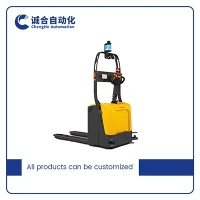
As a supplier of customized Automated Guided Vehicles (AGVs), I've seen firsthand how diverse the needs of our clients can be. Each industry, and sometimes each individual company, has specific requirements for their AGVs, which means we have to be well - versed in the communication protocols that make these machines operate efficiently. In this blog, I'm going to break down the different communication protocols used in our customized AGVs.
First up, let's talk about Wi - Fi. Yeah, you heard it right. Just like your home router, Wi - Fi plays a huge role in AGV communication. It's a wireless protocol that provides a flexible and convenient way for AGVs to connect to the central control system. With Wi - Fi, our AGVs can move freely within the facility without being restricted by physical cables. This is particularly useful in large warehouses and factories where AGVs need to cover a wide area.
One of the big advantages of Wi - Fi is its high data transfer rate. It allows for real - time communication between the AGV and the control center, which is crucial when you're dealing with tasks that require precise timing and coordination. For example, in a manufacturing plant, an AGV may need to pick up a component from one workstation and deliver it to another at a specific time. The high - speed data transfer of Wi - Fi ensures that the AGV receives accurate instructions and can follow the schedule.
However, Wi - Fi also has its limitations. Signal interference can be a major problem, especially in areas with a lot of electronic devices. In a modern industrial environment, there are often many machines emitting electromagnetic signals, which can disrupt the Wi - Fi connection. That's why we take extra care in setting up the Wi - Fi network for our AGVs, using signal boosters and choosing the right frequency bands to minimize interference.
Another important communication protocol we use is Ethernet. Ethernet is a wired protocol that offers a stable and reliable connection. Unlike Wi - Fi, it's not affected by signal interference, which makes it a great choice for applications where a consistent connection is a must. For instance, in a precision manufacturing facility, an AGV may be used to transport expensive and delicate components. Any interruption in communication could lead to costly mistakes, so Ethernet is the go - to option.
The downside of Ethernet is its lack of flexibility. Since the AGV has to be connected to the network via a cable, its movement is restricted. This is not suitable for applications where the AGV needs to move around freely in a large area. But for tasks that are more static or within a limited range, Ethernet is often the better option.
Bluetooth is also a protocol we sometimes incorporate into our customized AGVs. It's a short - range wireless protocol that's easy to set up and use. Bluetooth is great for communication between the AGV and other nearby devices, such as handheld scanners or sensors. For example, if an AGV is equipped with a barcode scanner to identify the products it's transporting, Bluetooth can be used to connect the scanner to the AGV's onboard computer.
The main advantage of Bluetooth is its low power consumption. This is important for AGVs, as they often rely on batteries for power. A low - power protocol like Bluetooth can help extend the AGV's operating time. However, its short range is a drawback. If you need to communicate with the AGV over a long distance, Bluetooth won't cut it.
Now, let's get into some of the newer and more advanced communication protocols. One such protocol is ZigBee. ZigBee is a wireless protocol that's designed for low - power, low - data - rate applications. It's based on the IEEE 802.15.4 standard and is often used in sensor networks. In the context of AGVs, ZigBee can be used to connect the AGV to a network of sensors in the facility, such as motion sensors and proximity sensors.
The benefit of ZigBee is its ability to form a mesh network. In a mesh network, each device (in this case, the AGV and the sensors) can act as a router, relaying data to other devices in the network. This allows for a more reliable and extensive communication network, even in areas with obstacles. However, like Bluetooth, ZigBee has a relatively short range and low data transfer rate, so it's not suitable for applications that require high - speed data communication.
CAN (Controller Area Network) is another protocol that's commonly used in our customized AGVs. CAN is a serial communication protocol that's widely used in the automotive and industrial sectors. It's known for its high reliability and fault - tolerance. In an AGV, CAN can be used to communicate between different onboard components, such as the motor control unit, the steering system, and the sensor system.
The advantage of CAN is its ability to handle multiple messages simultaneously. This is important for an AGV, as it has many different systems that need to communicate with each other in real - time. CAN also has a high level of error - detection and - correction capabilities, which ensures that the communication between the components is accurate and reliable.
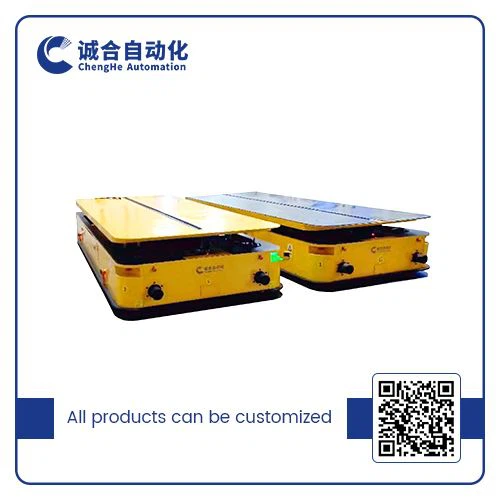
In our portfolio, we have some really cool customized AGV solutions. For example, check out our Dual Vehicle Linkage of 10T Load Backpack AGVs. This is a great example of how our AGVs use advanced communication protocols to work in tandem. These AGVs need to communicate with each other and the central control system to perform tasks like carrying heavy loads in a coordinated manner.
Our Composite AGV With Robotic Arm is another innovation. The robotic arm on this AGV needs to communicate effectively with the AGV's main control system, and the choice of communication protocol is crucial to ensure smooth operation.
And then there's our Automatic Stacker AGV. This AGV uses communication protocols to interact with the warehouse racking system and other equipment. The protocol needs to be reliable to ensure accurate stacking and retrieval of goods.
In conclusion, the choice of communication protocol for a customized AGV depends on a variety of factors, such as the application requirements, the environment, and the desired level of performance. As a supplier, we carefully evaluate these factors for each client to determine the most suitable protocol or combination of protocols. Whether it's Wi - Fi for flexibility, Ethernet for reliability, or one of the newer protocols like ZigBee or CAN, we have the expertise to make sure your AGV works efficiently.

If you're in the market for a customized AGV and want to learn more about how our communication protocols can meet your specific needs, don't hesitate to reach out. We'd love to have a conversation and see how we can help you optimize your material handling processes.
References
- IEEE Communications Society. "Communication Protocols for Industrial Automation." IEEE Journal on Industrial Electronics.
- International Electrotechnical Commission. "Standards for Wireless and Wired Communication in Industrial Environments." IEC Publications.