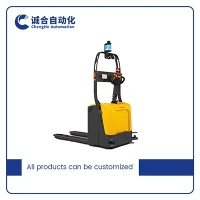
As a supplier of Composite Automated Guided Vehicles (AGVs), I've seen firsthand how crucial path planning is for these machines. A well - optimized path can boost efficiency, cut down on costs, and make the whole operation a lot smoother. In this blog, I'll share some tips on how to optimize the path planning of a Composite AGV.
Understanding the Basics of Composite AGV Path Planning
Before we dig into optimization, let's quickly go over what path planning for a Composite AGV is all about. Path planning is the process of figuring out the best route for the AGV to move from one point to another in a given environment. This involves taking into account things like the layout of the workspace, obstacles, traffic flow, and the AGV's capabilities.
Composite AGVs are pretty cool because they can handle different types of tasks and operate in various environments. They might be used in warehouses, factories, or even outdoor settings. But no matter where they're working, the goal of path planning remains the same: to get the AGV to its destination as fast and safely as possible.
Factors Affecting Composite AGV Path Planning
There are several factors that can have an impact on how we plan the path for a Composite AGV.
Workspace Layout: The layout of the workspace is a major factor. Is it a small, cramped warehouse with narrow aisles, or a large, open factory floor? The shape and size of the area will determine what routes are possible for the AGV. For example, in a warehouse with narrow aisles, the AGV might need to make tight turns, which will affect the path planning.
Obstacles: Obstacles are another big consideration. These can be static, like columns or storage racks, or dynamic, like other AGVs, workers, or moving equipment. The path planner needs to find a way to avoid these obstacles while still getting the AGV to its destination.
Traffic Flow: In a busy environment, traffic flow is crucial. If there are multiple AGVs operating in the same area, we need to plan their paths to prevent collisions and congestion. This might involve setting up one - way lanes or specific traffic rules for the AGVs.
AGV Capabilities: Each Composite AGV has its own set of capabilities, such as its speed, turning radius, and load - carrying capacity. These capabilities need to be factored into the path planning. For example, if an AGV has a large turning radius, it might not be able to take sharp corners, so the path needs to be planned accordingly.
Optimization Strategies for Composite AGV Path Planning
Map - Based Planning
One of the most common ways to plan the path of a Composite AGV is by using a map. We can create a digital map of the workspace, which includes all the static obstacles and the layout of the area. The AGV can then use this map to plan its route.


There are different algorithms that can be used for map - based planning, such as A* (A - star) algorithm. This algorithm searches for the shortest path between two points on the map, taking into account the cost of moving through different areas. For example, it might assign a higher cost to areas with a lot of obstacles or narrow passages.
Real - Time Adaptation
In a dynamic environment, real - time adaptation is essential. The AGV needs to be able to adjust its path on the fly if it encounters unexpected obstacles or changes in the environment. This can be achieved using sensors, such as lasers, cameras, or ultrasonic sensors, which can detect obstacles in real - time.
When an obstacle is detected, the AGV can use an algorithm to quickly recalculate its path. For example, it might use a local path planning algorithm, which focuses on finding a new path in the immediate vicinity of the AGV.
Traffic Management
As I mentioned earlier, traffic management is crucial in a multi - AGV environment. One way to manage traffic is by using a centralized control system. This system can monitor the positions and movements of all the AGVs in the area and assign paths to them to avoid collisions and congestion.
Another approach is to use decentralized traffic management, where each AGV communicates with its neighboring AGVs to coordinate their movements. This can be done using wireless communication technologies, such as Wi - Fi or Bluetooth.
Utilizing Customized AGVs for Better Path Planning
At our company, we offer a range of Customized AGV Forklift that can be tailored to specific path planning needs. For example, if you have a warehouse with a unique layout, we can customize an AGV forklift to fit the requirements of that environment.
Our Customized Heavy Duty Explosion - Proof Automatic Transfer Cart is also a great option for industries where safety is a top priority. These carts can be programmed to follow specific paths in hazardous environments, ensuring the safety of both the equipment and the workers.
And if you need an AGV for a long - distance or extra - long workspace, our Customized Extra - Long Automated Guided Cart is the perfect solution. It can be designed to cover large distances efficiently while following an optimized path.
Testing and Validation
Once we've planned the path for a Composite AGV, it's important to test and validate it. This can be done using simulation software, which allows us to model the AGV's movement in the virtual environment. We can test different scenarios, such as the presence of obstacles or changes in traffic flow, to see how the AGV will respond.
After the simulation, we can conduct real - world tests. This involves running the AGV in the actual workspace and monitoring its performance. We can collect data on things like travel time, energy consumption, and the number of collisions to evaluate the effectiveness of the path planning.
Conclusion
Optimizing the path planning of a Composite AGV is a complex but rewarding task. By taking into account factors like workspace layout, obstacles, traffic flow, and AGV capabilities, and using strategies like map - based planning, real - time adaptation, and traffic management, we can create efficient and safe paths for these machines.
At our company, we're committed to providing high - quality Composite AGVs and helping our customers optimize their path planning. If you're interested in learning more about our products or need help with path planning for your AGV, don't hesitate to reach out to us. We're here to assist you with all your AGV needs and look forward to discussing how we can help you improve your operations through better path planning.
References
- LaValle, S. M. (2006). Planning algorithms. Cambridge university press.
- Thrun, S., Burgard, W., & Fox, D. (2005). Probabilistic robotics. MIT press.