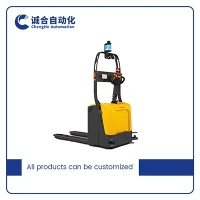
When it comes to the world of Automated Guided Vehicles (AGVs), one question that often arises is, "What is the width of Special Custom AGV?" As a supplier of Special Custom AGVs, I'm here to delve into this topic, exploring the factors that influence AGV width and how it can be tailored to specific industrial needs.
Understanding the Basics of Special Custom AGVs
Special Custom AGVs are not your run - of - the - mill automated vehicles. They are designed to meet the unique requirements of various industries, from manufacturing and warehousing to logistics and hazardous environments. These AGVs can be customized in terms of size, payload capacity, navigation system, and of course, width.
The width of an AGV is a crucial parameter as it directly impacts its maneuverability, the space it requires for operation, and its compatibility with existing infrastructure. For instance, in a narrow - aisle warehouse, a wide AGV may not be able to navigate through the aisles efficiently, while in a large - scale manufacturing plant, a wider AGV might be needed to carry larger payloads.
Factors Influencing the Width of Special Custom AGVs
Payload Capacity
One of the primary factors that determine the width of a Special Custom AGV is its payload capacity. AGVs designed to carry heavy loads typically need to be wider to provide a stable base. For example, our Explosion - proof Heavy Duty Tugger AGV 90T is built to handle extremely heavy payloads. The wide base of this AGV ensures that it can distribute the weight evenly, preventing tipping and ensuring safe and stable transportation. The width is carefully calculated based on the maximum load it is designed to carry, as well as the type of load (e.g., whether it is a single large item or multiple smaller items).
Navigation Requirements
The navigation system of an AGV also plays a role in determining its width. AGVs that use magnetic tape or wire guidance systems may have different width requirements compared to those using laser or vision - based navigation. For example, AGVs with magnetic tape guidance need to have a width that allows the sensors to accurately follow the tape. In some cases, wider AGVs may be able to accommodate more sensors or a more sophisticated sensor array, which can improve navigation accuracy.
Operational Environment
The environment in which the AGV will operate is another critical factor. In a crowded manufacturing floor with many obstacles, a narrower AGV may be more suitable as it can navigate through tight spaces more easily. On the other hand, in an open - air logistics yard, a wider AGV may be preferred as it can carry larger volumes of goods and has more stability. Our Scissor Lift Platform AGV is designed to operate in various environments. Its width can be customized to fit different workspaces, whether it's a confined maintenance area or a large - scale distribution center.
Compatibility with Existing Infrastructure
Special Custom AGVs need to be compatible with the existing infrastructure in the facility. This includes doorways, conveyors, and storage racks. If an AGV is too wide, it may not be able to pass through doorways or interface with conveyors properly. Therefore, the width of the AGV must be carefully considered in relation to the dimensions of the infrastructure. For example, if a facility has standard - sized doorways, the AGV width should be designed to fit through these doorways without any modifications.
Customizing the Width of Special Custom AGVs
As a supplier, we understand that each customer has unique requirements. That's why we offer a high degree of customization when it comes to the width of our Special Custom AGVs. Our team of engineers works closely with customers to understand their specific needs, including the payload, navigation requirements, operational environment, and infrastructure compatibility.
We start by conducting a detailed site survey and analysis. This involves measuring the available space, identifying potential obstacles, and understanding the workflow in the facility. Based on this information, we can recommend an appropriate width for the AGV. In some cases, we may even suggest a range of widths that can provide the best balance between maneuverability and payload capacity.
Once the width is determined, our engineers use advanced design software to create a 3D model of the AGV. This allows us to visualize the AGV in the customer's facility and make any necessary adjustments before manufacturing. We also perform simulations to ensure that the AGV can operate safely and efficiently within the specified width.
Examples of Special Custom AGV Widths
Let's take a look at some examples of how the width of our Special Custom AGVs can vary based on different applications.
Warehouse Applications
In a typical warehouse setting, where narrow - aisle storage is common, we may design an AGV with a width of around 800 - 1200 mm. This allows the AGV to navigate through the aisles easily while still being able to carry a reasonable payload. For example, a narrow - aisle AGV used for picking and transporting small to medium - sized items may have a width of 900 mm. This width enables it to access the storage racks efficiently and move quickly between different locations in the warehouse.
Manufacturing Applications
In a manufacturing plant, the width of the AGV may be determined by the size of the workpieces or equipment it needs to transport. For instance, an AGV used to move large machine parts may have a width of 2000 - 3000 mm. This wider AGV can provide a stable platform for carrying heavy and bulky items. Our Composite AGV With Robotic Arm can be customized with different widths depending on the manufacturing process. If it is used in a process where it needs to interact with multiple workstations closely, a narrower width may be chosen for better maneuverability.
Hazardous Environments
In hazardous environments, such as chemical plants or oil refineries, the width of the AGV is also influenced by safety requirements. The Explosion - proof Heavy Duty Tugger AGV 90T mentioned earlier is designed with a width that not only provides stability for heavy loads but also ensures that it can operate safely in potentially explosive atmospheres. The width may be adjusted to accommodate additional safety features, such as explosion - proof enclosures and sensors.
The Importance of Width in Special Custom AGVs
The width of a Special Custom AGV is not just a physical dimension; it has a significant impact on the overall performance and efficiency of the AGV system. A well - designed width can improve maneuverability, increase payload capacity, and enhance compatibility with the operational environment.
By choosing the right width for your AGV, you can optimize your workflow, reduce the risk of accidents, and improve the overall productivity of your facility. For example, a narrow - width AGV in a warehouse can increase the storage density by allowing for narrower aisles, while a wide - width AGV in a manufacturing plant can handle larger payloads more efficiently.
Contact Us for Your Special Custom AGV Needs
If you are considering implementing a Special Custom AGV in your facility, we are here to help. Our team of experts can work with you to determine the optimal width for your specific application, as well as provide comprehensive solutions for your AGV requirements. Whether you need an AGV for a warehouse, manufacturing plant, or hazardous environment, we have the expertise and experience to deliver a customized solution that meets your needs.


Contact us today to start the discussion about your Special Custom AGV project. Let's work together to find the perfect width and configuration for your AGV, and take your operations to the next level.
References
- Tanchoco, J. M. A., & Kutanoglu, E. (2003). Design and control of automated guided vehicle systems. Handbook of transportation science, 249 - 272.
- Vis, I. F. A., & de Koster, R. (2011). Warehouse design and control: framework and literature review. European Journal of Operational Research, 212(2), 1 - 10.
- Tharumarajah, A., & Ho, C. K. (2008). The design of automated guided vehicle systems: a state - of - the - art review. International Journal of Production Research, 46(12), 3249 - 3262.