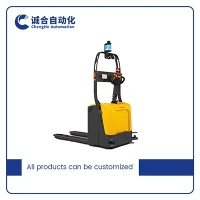
As a supplier of Automatic Stacking AGVs, I am often asked about the data transmission methods of these advanced machines. In this blog post, I will delve into the various data transmission methods used in Automatic Stacking AGVs, exploring their features, advantages, and applications.
Introduction to Automatic Stacking AGVs
Automatic Stacking AGVs are intelligent vehicles designed to automate the process of stacking and retrieving goods in warehouses and logistics centers. These AGVs are equipped with advanced sensors, navigation systems, and control algorithms to operate autonomously, efficiently, and safely. Data transmission plays a crucial role in the operation of Automatic Stacking AGVs, as it enables the exchange of information between the AGV and the central control system, as well as between the AGV and other devices in the warehouse.
Wired Data Transmission
One of the traditional data transmission methods used in Automatic Stacking AGVs is wired communication. Wired connections, such as Ethernet cables, provide a reliable and stable data transmission channel with high bandwidth and low latency. This method is suitable for applications where the AGV operates in a fixed area and requires a continuous and high-speed data connection.
-
Advantages of Wired Data Transmission
- High Reliability: Wired connections are less susceptible to interference from electromagnetic fields, radio frequency signals, and environmental factors, ensuring a stable and reliable data transmission.
- High Bandwidth: Ethernet cables can support high data transfer rates, allowing for the rapid exchange of large amounts of data between the AGV and the central control system.
- Low Latency: Wired connections have minimal latency, which is crucial for real-time control and monitoring of the AGV's operation.
-
Disadvantages of Wired Data Transmission
- Limited Mobility: Wired connections restrict the mobility of the AGV, as it needs to be physically connected to the power source and the data network. This limitation makes it difficult to use wired data transmission in applications where the AGV needs to move freely in the warehouse.
- Installation and Maintenance: The installation and maintenance of wired connections can be complex and costly, especially in large warehouses with multiple AGVs.
Wireless Data Transmission
Wireless data transmission has become increasingly popular in Automatic Stacking AGVs due to its flexibility and mobility. There are several wireless communication technologies available, each with its own characteristics and applications.
-
Wi-Fi
Wi-Fi is a widely used wireless communication technology that provides high-speed data transfer over a relatively short distance. In Automatic Stacking AGVs, Wi-Fi can be used to establish a wireless connection between the AGV and the central control system, allowing for real-time monitoring and control of the AGV's operation.- Advantages of Wi-Fi
- High Data Transfer Rate: Wi-Fi can support data transfer rates of up to several hundred megabits per second, enabling the rapid exchange of large amounts of data.
- Wide Coverage: Wi-Fi access points can be installed throughout the warehouse to provide a wide coverage area, allowing the AGV to maintain a continuous connection as it moves around.
- Compatibility: Wi-Fi is a standardized technology that is compatible with a wide range of devices, making it easy to integrate into existing warehouse management systems.
- Disadvantages of Wi-Fi
- Interference: Wi-Fi signals can be easily interfered with by other wireless devices, such as Bluetooth devices, microwave ovens, and other Wi-Fi networks, which can affect the reliability and performance of the data transmission.
- Limited Range: The range of Wi-Fi signals is limited, and the AGV may lose connection if it moves too far away from the access point.
- Advantages of Wi-Fi
-
Bluetooth
Bluetooth is a short-range wireless communication technology that is commonly used for connecting devices such as smartphones, tablets, and sensors. In Automatic Stacking AGVs, Bluetooth can be used for short-range data transfer between the AGV and other devices, such as handheld scanners or sensors.- Advantages of Bluetooth
- Low Power Consumption: Bluetooth devices consume very little power, which is ideal for battery-powered AGVs.
- Easy to Use: Bluetooth is a user-friendly technology that is easy to pair and connect with other devices.
- Low Cost: Bluetooth modules are relatively inexpensive, making it a cost-effective solution for short-range data transfer.
- Disadvantages of Bluetooth
- Limited Range: The range of Bluetooth signals is typically limited to a few meters, which restricts its use in large warehouses.
- Low Data Transfer Rate: Bluetooth has a relatively low data transfer rate compared to Wi-Fi, which may not be suitable for applications that require high-speed data transfer.
- Advantages of Bluetooth
-
ZigBee
ZigBee is a low-power, low-data-rate wireless communication technology that is designed for applications that require long battery life and low-cost communication. In Automatic Stacking AGVs, ZigBee can be used for sensor data collection and monitoring, as well as for communication between the AGV and other devices in the warehouse.- Advantages of ZigBee
- Low Power Consumption: ZigBee devices consume very little power, which is ideal for battery-powered sensors and devices.
- Long Battery Life: The low power consumption of ZigBee devices allows for long battery life, reducing the need for frequent battery replacement.
- Mesh Network: ZigBee supports mesh networking, which allows multiple devices to communicate with each other over a large area.
- Disadvantages of ZigBee
- Low Data Transfer Rate: ZigBee has a relatively low data transfer rate compared to Wi-Fi and Bluetooth, which may not be suitable for applications that require high-speed data transfer.
- Limited Range: The range of ZigBee signals is typically limited to a few tens of meters, which may not be sufficient for large warehouses.
- Advantages of ZigBee
Cellular Communication
Cellular communication, such as 4G and 5G, can also be used for data transmission in Automatic Stacking AGVs. Cellular networks provide wide coverage and high-speed data transfer, making them suitable for applications where the AGV needs to operate over a large area or in remote locations.
-
Advantages of Cellular Communication
- Wide Coverage: Cellular networks have a wide coverage area, allowing the AGV to maintain a connection even when it moves outside the warehouse.
- High Data Transfer Rate: 4G and 5G networks can support high data transfer rates, enabling the rapid exchange of large amounts of data.
- Mobility: Cellular communication allows the AGV to move freely without the need for a fixed infrastructure, making it suitable for applications where the AGV needs to operate in different locations.
-
Disadvantages of Cellular Communication
- Cost: Cellular communication can be expensive, especially for applications that require high data usage.
- Latency: Cellular networks may have higher latency compared to wired and wireless local area networks, which may affect the real-time control and monitoring of the AGV's operation.
Hybrid Data Transmission
In some cases, a hybrid data transmission approach may be used to combine the advantages of different communication technologies. For example, a combination of Wi-Fi and cellular communication can be used to provide both high-speed data transfer within the warehouse and wide coverage outside the warehouse.
Conclusion
In conclusion, the data transmission method used in Automatic Stacking AGVs depends on various factors, such as the application requirements, the environment, and the cost. Wired data transmission provides high reliability and bandwidth but has limited mobility, while wireless data transmission offers flexibility and mobility but may be affected by interference and range limitations. Cellular communication provides wide coverage and high-speed data transfer but can be expensive. A hybrid data transmission approach may be the best solution in some cases, combining the advantages of different communication technologies.


As a supplier of Automatic Stacking AGVs, we offer a range of data transmission solutions to meet the specific needs of our customers. Our Composite Mobile Robot, Customized Counterbalanced Forklift AGV, and Scissor Lift AGV are equipped with advanced data transmission technologies to ensure reliable and efficient operation.
If you are interested in learning more about our Automatic Stacking AGVs and data transmission solutions, please contact us for a detailed consultation. We look forward to working with you to optimize your warehouse operations.
References
- "Industrial Wireless Communication Technologies: A Survey" by Li, Y., et al.
- "Wireless Sensor Networks: A Survey" by Akyildiz, I. F., et al.
- "Cellular Communication for Industrial Internet of Things: A Survey" by Zhang, Y., et al.