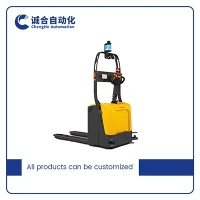
Hey there! As a supplier of Customized Automated Guided Vehicles (AGVs), I've had my fair share of experiences diving deep into the world of motion - control algorithms. These algorithms are like the brains behind our AGVs, making sure they move smoothly, accurately, and safely. So, let's take a closer look at some of the motion - control algorithms used in our Customized AGVs.
PID Control Algorithm
One of the most common motion - control algorithms we use is the Proportional - Integral - Derivative (PID) control algorithm. It's a classic, and for good reason. The PID controller works by calculating an error value as the difference between a desired setpoint and the current process variable.
Let me break it down a bit. The proportional term responds to the current error. If the AGV is far from its target position, the proportional gain will generate a large control output to move it quickly towards the target. The integral term, on the other hand, takes into account the past errors. It accumulates the error over time and helps eliminate any steady - state error. For example, if there's a small but persistent deviation from the desired path, the integral term will gradually adjust the control output to correct it. The derivative term looks at the rate of change of the error. It helps to dampen oscillations and makes the system more stable. If the AGV is approaching the target too fast, the derivative term will reduce the control output to slow it down smoothly.
We use PID controllers in many of our Customized AGVs, especially when it comes to speed and position control. It's a simple yet effective algorithm that can be easily tuned to meet the specific requirements of different applications. Whether it's a small AGV moving around a warehouse or a large - scale AGV used in industrial manufacturing, PID control can do the job.
Fuzzy Logic Control
Another interesting motion - control algorithm we often employ is fuzzy logic control. Unlike traditional control algorithms that rely on precise mathematical models, fuzzy logic control uses linguistic variables and fuzzy rules. It's more like how humans make decisions based on imprecise or uncertain information.
Let's say an AGV is moving in an environment where there are obstacles. With fuzzy logic control, we can define rules like "if the distance to the obstacle is short and the speed is high, then reduce the speed significantly". These rules are based on fuzzy sets, such as "short", "high", and "significantly". The controller then evaluates these rules and makes a decision on how to adjust the AGV's motion.
Fuzzy logic control is great for our Customized AGVs because it can handle complex and uncertain situations. It doesn't require a detailed mathematical model of the AGV and its environment, which makes it more flexible. For example, in a dynamic warehouse environment where the layout and the position of obstacles can change, fuzzy logic control can adapt the AGV's motion in real - time. You can learn more about our AGV's adaptability in complex scenarios through our AGV Multi - Vehicle Coordination service.
Model Predictive Control (MPC)
Model Predictive Control is a more advanced motion - control algorithm that we use in some of our high - end Customized AGVs. MPC uses a mathematical model of the system to predict its future behavior over a certain time horizon. Based on these predictions, it calculates an optimal control sequence to minimize a predefined cost function.
For our AGVs, the cost function might include factors like the distance to the target, the energy consumption, and the safety margin. MPC takes into account the constraints of the system, such as the maximum speed and acceleration of the AGV. It then optimizes the control inputs to achieve the best performance within these constraints.


One of the advantages of MPC is its ability to handle multiple objectives and constraints simultaneously. For example, in a large - scale logistics center, our AGVs need to move quickly to meet the delivery deadlines while also minimizing energy consumption and avoiding collisions. MPC can balance these different requirements and find the optimal motion strategy. Check out our Dual Vehicle Linkage of 10T Load Backpack AGVs to see how MPC can be applied in heavy - load AGV operations.
Adaptive Control
Adaptive control is also an important motion - control algorithm for our Customized AGVs. In real - world applications, the parameters of the AGV and its environment can change over time. For example, the load on the AGV might vary, or the surface conditions of the floor might change. Adaptive control algorithms can adjust the control parameters in real - time to compensate for these changes.
There are different types of adaptive control, such as model reference adaptive control and self - tuning control. In model reference adaptive control, the AGV's behavior is compared to a reference model. If there's a difference between the actual behavior and the reference model, the control parameters are adjusted to minimize this difference. Self - tuning control, on the other hand, uses an on - line parameter estimation algorithm to estimate the system parameters and then adjusts the control parameters accordingly.
Adaptive control ensures that our AGVs can maintain good performance even in changing conditions. It's especially useful in applications where the operating environment is unpredictable.
Choosing the Right Algorithm
So, how do we choose the right motion - control algorithm for our Customized AGVs? Well, it depends on several factors. The first factor is the application requirements. If the AGV needs to move with high precision in a stable environment, a PID controller might be sufficient. However, if the environment is complex and uncertain, fuzzy logic control or MPC might be more appropriate.
The cost is also an important consideration. Some advanced algorithms like MPC require more computational resources, which can increase the cost of the AGV. We need to balance the performance requirements with the cost to provide our customers with the best value.
The ease of implementation and maintenance is another factor. We want to use algorithms that are easy to implement and maintain, especially for our customers who might not have a lot of technical expertise.
Conclusion
In conclusion, motion - control algorithms play a crucial role in the performance of our Customized AGVs. Whether it's the classic PID control, the flexible fuzzy logic control, the advanced MPC, or the adaptive control, each algorithm has its own advantages and is suitable for different applications.
At our company, we are committed to providing the best Customized AGV solutions for our customers. We carefully select and optimize the motion - control algorithms based on the specific requirements of each project. If you're interested in our Customized AGV Service, don't hesitate to contact us for a procurement discussion. We're looking forward to working with you to meet your unique AGV needs.
References
- Ogata, K. (2010). Modern Control Engineering. Prentice Hall.
- Tanaka, K., & Wang, H. O. (2001). Fuzzy Control Systems Design and Analysis: A Linear Matrix Inequality Approach. Wiley.
- Maciejowski, J. M. (2002). Predictive Control: With Constraints. Prentice Hall.