


Hey there! I'm from a Special AGV supplier, and today I wanna chat about how Special AGVs work. These little (or sometimes not - so - little) machines are pretty cool, and they've got a big impact on all sorts of industries.
Let's start with the basics. An AGV, or Automated Guided Vehicle, is a vehicle that moves around without a human driver. Special AGVs, well, they're just that - special. They're designed to handle unique tasks that regular AGVs might not be up for.
1. Navigation Systems
One of the most important parts of how a Special AGV works is its navigation system. There are a few different types out there.
Laser Navigation
Laser navigation is super common. The AGV has a laser scanner on it. This scanner sends out laser beams in all directions. When the beams hit objects in the environment, they bounce back to the scanner. The AGV's computer then uses this information to create a map of its surroundings. It knows where it is in relation to these objects and can plan a path to its destination. For example, in a warehouse full of racks, the AGV can use laser navigation to find its way between the racks to pick up or drop off goods.
Vision Navigation
Vision navigation uses cameras. The cameras on the AGV take pictures of the environment. The AGV's software analyzes these pictures to recognize landmarks, like signs or markings on the floor. It can then figure out where it is and where it needs to go. This is really useful in places where there are visual cues, like in a factory with specific markings on the production line.

Magnetic Navigation
Magnetic navigation involves magnets placed on the floor. The AGV has sensors that can detect these magnets. It follows a pre - defined path based on the pattern of the magnets. This is a simple and reliable way of navigation, especially in areas where the path doesn't change often, like in a fixed - route material handling system.
2. Power Systems
Special AGVs need power to move around. There are a couple of main power sources.
Battery Power
Most Special AGVs run on batteries. Lithium - ion batteries are becoming more and more popular because they have a high energy density. This means they can store a lot of energy in a relatively small space. The AGV can be charged at a charging station when its battery gets low. Some AGVs are designed to automatically go to the charging station when they need a top - up. For example, in a 24/7 operation, the AGV can take a short break to charge and then get back to work.
Fuel Cell Power
Fuel cell power is another option. Fuel cells convert chemical energy into electrical energy. They offer longer run times compared to batteries in some cases. However, they're a bit more expensive and require more maintenance. But for applications where continuous operation is crucial, like in large - scale logistics centers, fuel cell - powered AGVs can be a great choice.
3. Load Handling
Special AGVs are often used to move loads. The way they handle loads depends on the type of AGV and the task.
Forklift AGVs
Forklift AGVs have forks, just like a regular forklift. They can lift pallets or other heavy objects. These AGVs are programmed to approach the load, lift it up using the forks, and then transport it to the desired location. They're commonly used in warehouses for moving inventory.
Tugger AGVs
Tugger AGVs are used to tow trailers or carts. They have a coupling mechanism that attaches to the trailer. They can pull multiple trailers at once, making them great for moving large amounts of materials in a factory or distribution center.
Lifting AGVs
Lifting AGVs are designed to lift and move loads vertically. They can be used in multi - level storage systems. For example, they can lift a load from the ground floor to a higher shelf in a racking system.
4. Safety Systems
Safety is a big deal when it comes to Special AGVs. They're moving around in areas where there might be people or other equipment.
Bumpers and Sensors
AGVs are usually equipped with bumpers. If the AGV hits an object, the bumper triggers a safety mechanism that stops the AGV. There are also sensors, like proximity sensors. These sensors can detect when an object is getting too close to the AGV. When this happens, the AGV slows down or stops to avoid a collision.
Emergency Stop Buttons
Emergency stop buttons are another important safety feature. Operators can press these buttons in case of an emergency to immediately stop the AGV.
Warning Lights and Alarms
AGVs often have warning lights and alarms. The lights can flash to indicate that the AGV is in operation, and the alarms can sound when there's a problem or when the AGV is approaching an area.
5. Special Features
Some Special AGVs come with really unique features.
Dual AGV Linkage
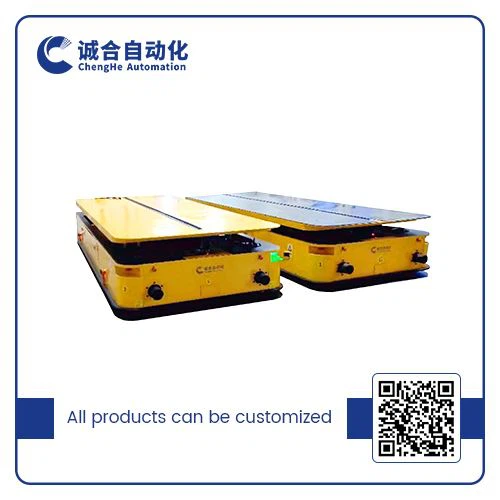
Check out Dual AGV Linkage. This is a feature where two AGVs can work together. They can be synchronized to move a very large or heavy load. For example, in a construction site, two AGVs linked together can move a massive pre - fabricated building component.
Composite Mobile Robot
The Composite Mobile Robot is another interesting one. It combines different functions, like picking, sorting, and transporting. It can adapt to different tasks in a flexible way. In an e - commerce fulfillment center, a composite mobile robot can pick items from the shelves, sort them according to orders, and then transport them to the packing area.
Explosion - proof Unmanned Transport Truck
For industries where there's a risk of explosion, like in the chemical or oil and gas industry, the Explosion - proof Unmanned Transport Truck is a game - changer. It's designed to operate safely in explosive environments, with special features to prevent sparks and other potential ignition sources.
6. Integration with Other Systems
Special AGVs don't work in isolation. They need to be integrated with other systems in a facility.
Warehouse Management Systems (WMS)
In a warehouse, the AGV needs to communicate with the WMS. The WMS tells the AGV where to pick up and drop off goods. It also provides information about the inventory levels. For example, when a new order comes in, the WMS can send a command to the AGV to go to the appropriate rack to pick up the items.
Manufacturing Execution Systems (MES)
In a manufacturing plant, the AGV can be integrated with the MES. The MES can send production - related instructions to the AGV. For example, it can tell the AGV to move raw materials to a specific production line at a certain time.
7. Contact for Purchase and洽谈
If you're interested in our Special AGVs and want to learn more about how they can benefit your business, we'd love to talk to you. Whether you're in a warehouse, a factory, or any other industry that could use the help of these amazing machines, we've got the right solution for you. Reach out to us to start a conversation about your specific needs and how our Special AGVs can fit into your operations.
References
- Some textbooks on automated material handling systems
- Industry reports on the development of AGV technology
So, that's a rundown of how Special AGVs work. They're complex but really useful machines that are changing the way we do business. If you have any questions, feel free to ask!


