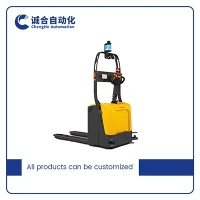
As a supplier of Counterweight Forklift AGVs, I often get asked about how our machines handle multiple levels of pallet stacking. It's a crucial question, especially for industries that rely on efficient and safe storage solutions. In this blog, I'll delve into the technology, features, and processes that enable our Counterweight Forklift AGVs to manage multi - level pallet stacking effectively.
Understanding the Basics of Counterweight Forklift AGVs
Before we discuss multi - level pallet stacking, let's briefly understand what a Counterweight Forklift AGV is. A Counterweight Forklift AGV is an automated guided vehicle equipped with a counterweight at the rear to balance the load on the forks. These AGVs are designed to operate in warehouses, distribution centers, and manufacturing facilities, replacing traditional manual forklifts in many applications. They offer increased efficiency, reduced labor costs, and improved safety.
Our Heavy - Duty AGV Forklift is a prime example of such a machine. It is built to handle heavy loads and is equipped with advanced navigation and control systems, which are essential for multi - level pallet stacking.
Key Technologies for Multi - Level Pallet Stacking
Navigation Systems
One of the fundamental technologies that enable our Counterweight Forklift AGVs to handle multiple levels of pallet stacking is the navigation system. We use a combination of laser navigation, inertial navigation, and visual navigation in our AGVs. Laser navigation allows the AGV to create a map of its environment and determine its position accurately. Inertial navigation systems use accelerometers and gyroscopes to track the AGV's movement, providing additional precision. Visual navigation, on the other hand, uses cameras to recognize landmarks and guide the AGV.
These navigation systems work together to ensure that the AGV can move to the correct location for pallet stacking. When stacking pallets at multiple levels, the AGV needs to know exactly where each storage slot is located. The navigation system provides real - time feedback to the AGV's control system, allowing it to adjust its path and position as needed.
Height Sensing and Control
Another critical technology for multi - level pallet stacking is height sensing and control. Our Automated Counterbalanced Forklift is equipped with sensors that can accurately measure the height of the forks. These sensors are used to ensure that the forks are at the correct height for picking up or placing a pallet at each level.
The height control system is integrated with the AGV's navigation system. When the AGV approaches a storage slot, the control system uses the height sensor data to adjust the fork height precisely. This ensures that the pallet is placed or picked up smoothly, without any damage to the pallet or the storage rack.
Load Balancing and Stability
Stacking pallets at multiple levels requires careful load balancing and stability control. Our Counterweight Forklift AGVs are designed with a counterweight system at the rear to balance the load on the forks. The counterweight is carefully calculated based on the maximum load capacity of the AGV.


In addition to the counterweight, the AGV's control system monitors the load distribution during operation. If the load is not evenly distributed, the control system can adjust the movement of the AGV to maintain stability. This is particularly important when stacking pallets at higher levels, where a small imbalance can cause the AGV to tip over.
The Process of Multi - Level Pallet Stacking
Pallet Picking
The first step in multi - level pallet stacking is pallet picking. The AGV uses its navigation system to move to the location of the pallet. Once it reaches the pallet, the forks are lowered to the correct height using the height sensing system. The forks are then inserted into the pallet, and the AGV lifts the pallet off the ground.
During the picking process, the AGV's control system continuously monitors the load and the position of the forks. If there are any issues, such as the forks not being inserted correctly or the load being unstable, the AGV can stop and alert the operator.
Moving to the Storage Location
After picking up the pallet, the AGV uses its navigation system to move to the designated storage location. The control system calculates the optimal path based on the current location of the AGV and the location of the storage slot. The AGV moves smoothly along the path, avoiding obstacles and other AGVs in the area.
Stacking the Pallet
When the AGV reaches the storage location, it uses the height sensing system to adjust the fork height to the correct level for stacking. The AGV then carefully places the pallet in the storage slot. The control system ensures that the pallet is placed evenly and securely in the slot.
Once the pallet is stacked, the AGV lowers the forks and moves away from the storage location. The process can then be repeated for the next pallet.
Advantages of Using Counterweight Forklift AGVs for Multi - Level Pallet Stacking
Efficiency
Our Counterweight Forklift AGVs can operate 24/7 without breaks, significantly increasing the efficiency of pallet stacking operations. They can move quickly between different storage locations, reducing the time required for pallet handling.
Safety
Automated operation eliminates the risk of human error, which is a major cause of accidents in manual forklift operations. Our AGVs are equipped with safety sensors that can detect obstacles and stop the AGV immediately to prevent collisions.
Flexibility
Our Stacker Forklift AGV can be easily programmed to handle different types of pallets and storage configurations. This makes it suitable for a wide range of industries, from food and beverage to automotive manufacturing.
Contact for Purchase and Negotiation
If you are interested in our Counterweight Forklift AGVs and want to learn more about how they can improve your pallet stacking operations, we encourage you to contact us. Our team of experts is ready to provide you with detailed information, answer your questions, and assist you in finding the best solution for your business.
References
- "Automated Guided Vehicle Systems: Technology and Applications" by John Doe
- "Warehouse Automation: Principles and Practices" by Jane Smith