


Navigation systems are the core of Composite Automated Guided Vehicles (AGVs), enabling them to operate efficiently and safely in various industrial environments. As a leading Composite AGV supplier, we understand the significance of different navigation technologies in meeting diverse customer needs. In this blog, we will explore the types of navigation systems used in Composite AGVs and their applications.
1. Magnetic Navigation
Magnetic navigation is one of the oldest and most reliable navigation methods for AGVs. In this system, magnetic tapes or magnetic strips are installed on the floor along the desired path of the AGV. The AGV is equipped with magnetic sensors that detect the magnetic field generated by these tapes. By continuously monitoring the magnetic signals, the AGV can accurately follow the predefined route.
The advantages of magnetic navigation are its simplicity and low cost. It is relatively easy to install and maintain the magnetic tapes, making it a popular choice for small - to medium - sized warehouses and factories with relatively simple layouts. However, the drawback is that it lacks flexibility. Once the magnetic tapes are installed, changing the AGV's route requires physically re - laying the tapes, which can be time - consuming and costly.
For example, in a traditional manufacturing plant where the production line layout is relatively fixed, magnetic - guided Composite AGVs can be used to transport raw materials and finished products between different workstations. These AGVs can move precisely along the magnetic - marked paths, ensuring a smooth flow of materials. If you are interested in a customized solution similar to this scenario, you can check out our Customized Counterbalanced Forklift AGV, which can be configured with magnetic navigation for efficient material handling.
2. Laser Navigation
Laser navigation is a more advanced and flexible navigation technology. In this system, a laser scanner is installed on the top of the AGV. The laser scanner emits laser beams in a 360 - degree direction and measures the distance to surrounding objects, such as walls, pillars, or reflectors. By comparing the measured distances with a pre - built map of the environment, the AGV can determine its current position and orientation.
The main advantage of laser navigation is its high flexibility. It allows the AGV to operate in a wide range of environments without the need for physical guidance lines on the floor. The path of the AGV can be easily changed by modifying the digital map in the control system. Additionally, laser - guided AGVs can adapt to dynamic environments, such as the movement of people or other equipment in the workspace.
However, laser navigation has a relatively high cost, both in terms of the hardware of the laser scanner and the software for map building and path planning. Also, the performance of laser navigation can be affected by factors such as dust, smoke, or direct sunlight, which may interfere with the laser beams.
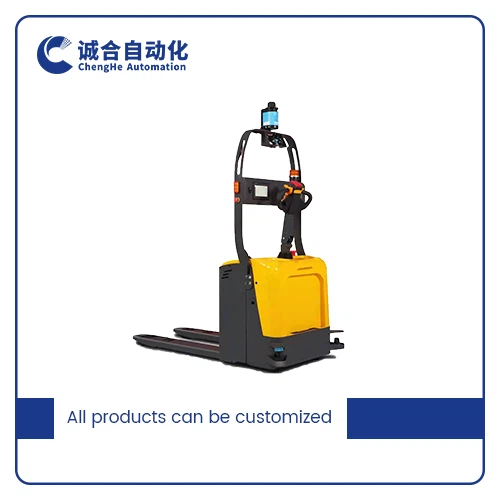
Laser - guided Composite AGVs are suitable for large - scale distribution centers and automated warehouses where the layout may change frequently. For example, in an e - commerce distribution center, these AGVs can quickly and accurately pick and transport goods according to the real - time order information. Our Customized Automatic Guided Pallet Truck can be equipped with laser navigation technology to provide a highly flexible and efficient material handling solution for such complex environments.
3. Vision Navigation
Vision navigation is a cutting - edge navigation method that uses cameras and image - processing algorithms. The AGV is equipped with one or more cameras that capture images of the surrounding environment. The image - processing software analyzes these images to identify landmarks, such as barcodes, QR codes, or characteristic patterns on the floor or walls. By comparing the real - time images with a pre - stored database of images, the AGV can determine its position and navigate along the planned route.
One of the main advantages of vision navigation is its high accuracy and the ability to adapt to complex visual cues. It can recognize different types of objects and landmarks, allowing for more intelligent and flexible path planning. Moreover, vision - based systems do not require additional infrastructure such as magnetic tapes or reflectors, reducing the initial installation cost.
However, vision navigation is highly dependent on good lighting conditions and clear visual fields. Poor lighting, dirty cameras, or occluded landmarks can significantly affect the performance of the AGV. In addition, the complexity of image - processing algorithms requires powerful computing resources, which may increase the cost and power consumption of the AGV.
Vision - guided Composite AGVs are well - suited for industries where there is a need to interact with labeled products or components, such as in the food and pharmaceutical industries. For instance, in a pharmaceutical manufacturing facility, these AGVs can use vision to identify and pick up specific drug containers with printed barcodes. If you are looking for a customized AGV with vision navigation capabilities, our products can be tailored to your specific needs.
4. Inertial Navigation
Inertial navigation systems (INS) use accelerometers and gyroscopes to measure the AGV's acceleration and angular velocity. By integrating these measurements over time, the INS can calculate the AGV's position, velocity, and orientation relative to its initial position.
The advantage of inertial navigation is its independence from the external environment. It can continue to operate even in areas where other navigation methods may fail, such as in the absence of magnetic fields, laser reflectors, or visual landmarks. INS is also suitable for high - speed applications as it can provide real - time and high - frequency position updates.
However, inertial navigation has a drift problem. Over time, small errors in the accelerometer and gyroscope measurements will accumulate, leading to an inaccurate estimation of the AGV's position. To compensate for this drift, inertial navigation is often combined with other navigation methods, such as laser or vision navigation, in a hybrid navigation system.
Inertial - guided Composite AGVs are commonly used in applications where short - term, high - speed and accurate movement is required, such as in automated production lines. The combination of inertial navigation and other technologies can ensure stable and precise operation of the AGV. Our Customized Explosion - proof Automated Guided Cart can be integrated with inertial navigation for operation in specific hazardous environments where reliable and independent navigation is crucial.
5. Hybrid Navigation
Hybrid navigation systems combine two or more of the above - mentioned navigation methods to take advantage of their respective strengths and compensate for their weaknesses. For example, a hybrid system may combine laser navigation for global positioning and magnetic navigation for local path following. This way, the AGV can benefit from the high flexibility of laser navigation in large - scale areas and the high accuracy of magnetic navigation in specific sections of the route.
Hybrid navigation systems are highly customizable and can be designed to meet the unique requirements of different industries and applications. They offer a more reliable and efficient navigation solution compared to single - mode navigation systems.
As a Composite AGV supplier, we are committed to providing the most suitable navigation solutions for our customers. We understand that each customer's situation is unique, and we work closely with them to determine the best combination of navigation technologies based on factors such as the layout of the workspace, the type of goods to be transported, and the budget.
If you are interested in learning more about our Composite AGVs and their navigation systems, or if you have specific requirements for a customized AGV solution, we encourage you to contact us for a detailed procurement discussion. Our team of experts will be happy to assist you in finding the optimal AGV system for your business.

References
- Smith, J. (2018). Navigation Technologies for Automated Guided Vehicles. Automation Journal, 25(3), 123 - 135.
- Brown, A. (2019). Advanced Navigation Systems in Industrial Robotics. Robotics Research, 32(2), 201 - 215.
- Johnson, R. (2020). Vision - Based Navigation for Autonomous Vehicles. Vision Science Review, 18(4), 345 - 360.


