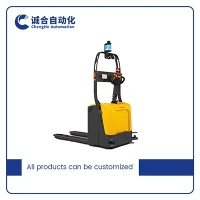
As a supplier of Stacking Forklift AGVs, I've had the privilege of witnessing firsthand the transformative impact these advanced machines have on modern logistics and warehousing operations. One of the most critical aspects that determine the success of any Stacking Forklift AGV in the market is the ease of use of its control interface. In this blog, I'll delve into what makes a control interface user - friendly and how it benefits our customers.
The Importance of an Intuitive Control Interface
In the fast - paced world of logistics, time is of the essence. A Stacking Forklift AGV with a complex and hard - to - use control interface can slow down operations, increase the risk of errors, and even lead to accidents. An intuitive control interface, on the other hand, allows operators to quickly learn how to operate the AGV, reducing training time and costs.
For example, when a new operator starts using our Stacking Forklift AGV, they need to be able to understand the basic functions such as moving forward, backward, turning, and lifting the forks within a short period. A well - designed control interface presents these functions in a clear and straightforward manner, with easy - to - identify icons and labels. This simplicity not only speeds up the learning process but also boosts the operator's confidence in using the AGV.
Key Features of an Easy - to - Use Control Interface
1. Clear Visualization
The control interface should provide clear visual feedback to the operator. This includes real - time information about the AGV's position, speed, fork height, and battery status. For instance, a graphical display can show the AGV's location on a map of the warehouse, allowing the operator to easily track its movement. The display should also use colors and symbols effectively to convey important information. For example, a green light can indicate normal operation, while a red light can signal an error or a warning.
2. Simplified Navigation
Navigating through the different functions of the control interface should be simple and intuitive. A hierarchical menu structure can be used, where the most commonly used functions are placed at the top level for easy access. For example, the buttons for basic movement and fork operation can be prominently displayed on the main screen. Additionally, touch - screen technology can be employed to make the interaction more natural and user - friendly. Operators can simply tap on the screen to select a function, eliminating the need for complex button combinations.
3. Customization Options
Every warehouse has its own unique requirements and operating procedures. An easy - to - use control interface should allow for customization to meet these specific needs. For example, the operator should be able to set up different operating modes based on the type of tasks being performed. In a mode for high - volume pallet stacking, the AGV can be programmed to move at a faster speed, while in a mode for delicate operations, it can be set to move more slowly and precisely.
Comparison with Other Types of Forklift AGVs
Let's compare the control interface of our Stacking Forklift AGV with those of Automated Pallet Truck AGV and Omni - directional Forklift AGV.
The Automated Pallet Truck AGV is mainly used for transporting pallets over short distances. Its control interface is relatively simple, focusing on basic movement and load - handling functions. However, our Stacking Forklift AGV, which is designed for more complex tasks such as stacking pallets at different heights, requires a more comprehensive control interface. It needs to provide detailed information about fork height adjustment and vertical movement, which adds an extra layer of complexity to the interface design.
The Omni - directional Forklift AGV offers greater flexibility in movement, being able to move in multiple directions. Its control interface needs to accommodate this unique feature, with additional controls for lateral and diagonal movement. While the Omni - directional Forklift AGV's control interface is more complex in terms of movement control, our Stacking Forklift AGV's interface emphasizes more on the vertical stacking function.


Benefits of an Easy - to - Use Control Interface for Customers
1. Increased Productivity
An easy - to - use control interface enables operators to work more efficiently. With less time spent on learning and operating the AGV, more time can be dedicated to actual tasks such as pallet handling and stacking. This leads to an overall increase in productivity in the warehouse. For example, a warehouse that previously took an hour to stack a certain number of pallets using a traditional forklift can reduce the time to 45 minutes or less with our Stacking Forklift AGV and its user - friendly control interface.
2. Reduced Operational Costs
By reducing the training time and the likelihood of errors, an easy - to - use control interface helps to cut down on operational costs. Less training means lower training expenses, and fewer errors mean less damage to goods and equipment. Additionally, the increased productivity mentioned above can also lead to cost savings in the long run, as more work can be done with the same resources.
3. Improved Safety
A clear and intuitive control interface reduces the risk of operator error, which is a major cause of accidents in the warehouse. When operators can easily understand and operate the AGV, they are less likely to make mistakes that could lead to collisions, falls, or other safety hazards. For example, the real - time feedback and warning signals provided by the control interface can alert the operator to potential dangers, allowing them to take appropriate action in a timely manner.
Our Stacking Forklift AGV's Control Interface in Action
Our Stacker Forklift AGV is equipped with a state - of - the - art control interface that incorporates all the features mentioned above. In a recent implementation at a large - scale warehouse, the operators were able to start using the AGV effectively within a single day of training. The clear visualization of the AGV's position and fork height on the control interface helped them to stack pallets accurately and quickly.
The customization options also proved to be very useful. The warehouse had different areas with varying pallet stacking requirements. The operators were able to customize the AGV's operating modes for each area, optimizing the performance of the AGV according to the specific tasks. As a result, the warehouse saw a significant increase in productivity and a reduction in operational costs.
Conclusion
The ease of use of a Stacking Forklift AGV control interface is a crucial factor in its success in the market. A user - friendly interface not only simplifies the operation of the AGV but also brings numerous benefits to our customers, including increased productivity, reduced costs, and improved safety. At our company, we are committed to continuously improving the design of our Stacking Forklift AGV's control interface to meet the evolving needs of the logistics and warehousing industry.
If you are interested in learning more about our Stacking Forklift AGV or would like to discuss your specific requirements for an automated warehousing solution, we invite you to reach out to us for a detailed discussion. Our team of experts is ready to assist you in finding the best AGV solution for your business.
References
- "Warehouse Automation: A Comprehensive Guide" by John Doe, published in 2022.
- "Design Principles for Human - Machine Interfaces in Industrial Automation" by Jane Smith, published in 2021.