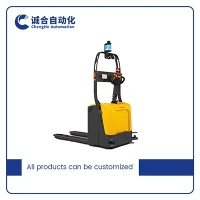
In the realm of modern logistics and manufacturing, Automated Guided Vehicles (AGVs) have emerged as a cornerstone technology, revolutionizing material handling and transportation within facilities. As an AGV Scheduling System supplier, we understand the critical role that system architecture design patterns play in optimizing the performance, efficiency, and reliability of AGV operations. In this blog post, we will explore the key system architecture design patterns for an AGV Scheduling System, delving into their benefits, applications, and considerations.
Centralized Architecture
One of the most common design patterns for an AGV Scheduling System is the centralized architecture. In a centralized system, all scheduling decisions are made by a single control unit, which communicates with all AGVs in the fleet. This central control unit is responsible for tasks such as route planning, task assignment, and traffic management.
The primary advantage of a centralized architecture is its simplicity and ease of management. With all scheduling logic concentrated in one place, it is easier to implement complex algorithms and optimize the overall performance of the AGV fleet. Additionally, a centralized system provides a single point of control, making it easier to monitor and manage the entire operation.
However, centralized architectures also have some limitations. Since all scheduling decisions are made by a single control unit, there is a risk of a single point of failure. If the central control unit malfunctions, the entire AGV fleet may come to a halt. Additionally, as the number of AGVs in the fleet increases, the computational load on the central control unit can become overwhelming, leading to performance degradation.
Decentralized Architecture
In contrast to the centralized architecture, a decentralized architecture distributes the scheduling decision-making process among multiple AGVs or local control units. Each AGV or local control unit is responsible for making its own scheduling decisions based on its local environment and information.
The main advantage of a decentralized architecture is its robustness and scalability. Since the scheduling decision-making process is distributed, there is no single point of failure. If one AGV or local control unit malfunctions, the other AGVs can continue to operate independently. Additionally, as the number of AGVs in the fleet increases, the decentralized architecture can easily scale to accommodate the additional load.
However, decentralized architectures also have some challenges. Coordinating the actions of multiple AGVs or local control units can be complex, and there is a risk of conflicts and collisions. Additionally, implementing a decentralized architecture requires more sophisticated communication and coordination mechanisms, which can increase the complexity and cost of the system.
Hybrid Architecture
A hybrid architecture combines the advantages of both centralized and decentralized architectures. In a hybrid system, some scheduling decisions are made by a central control unit, while others are made by individual AGVs or local control units.


For example, the central control unit can be responsible for high-level tasks such as task assignment and global route planning, while individual AGVs or local control units can be responsible for low-level tasks such as local path planning and collision avoidance. This approach allows for a balance between simplicity and robustness, as well as scalability and performance.
The hybrid architecture is particularly suitable for large-scale AGV deployments, where a centralized approach may become too complex and a decentralized approach may not provide enough coordination. By combining the strengths of both architectures, a hybrid system can optimize the performance and efficiency of the AGV fleet while maintaining a high level of reliability and flexibility.
Integration with Other Systems
In addition to choosing the right architecture for the AGV Scheduling System, it is also important to consider its integration with other systems in the facility. AGVs often operate in conjunction with other technologies such as Warehouse Management System, Manufacturing Execution System, and IO Integrated System.
Integrating the AGV Scheduling System with these systems can provide several benefits. For example, integrating with the Warehouse Management System can enable real-time inventory management and optimize the flow of materials within the warehouse. Integrating with the Manufacturing Execution System can ensure that AGVs are coordinated with the production process, improving overall productivity and efficiency. Integrating with the IO Integrated System can provide seamless communication between AGVs and other equipment in the facility, enabling a more automated and intelligent operation.
Considerations for System Architecture Design
When designing the system architecture for an AGV Scheduling System, several factors need to be considered. These factors include the size and complexity of the AGV fleet, the layout and topology of the facility, the type of tasks and operations performed by the AGVs, and the level of integration with other systems.
For example, in a small-scale AGV deployment with a simple layout and limited tasks, a centralized architecture may be sufficient. However, in a large-scale AGV deployment with a complex layout and diverse tasks, a hybrid or decentralized architecture may be more appropriate. Additionally, the level of integration with other systems should be carefully considered to ensure seamless communication and coordination.
Conclusion
In conclusion, the system architecture design patterns for an AGV Scheduling System play a crucial role in optimizing the performance, efficiency, and reliability of AGV operations. Whether you choose a centralized, decentralized, or hybrid architecture, it is important to consider the specific requirements and constraints of your facility. Additionally, integrating the AGV Scheduling System with other systems in the facility can provide significant benefits in terms of productivity, efficiency, and automation.
As an AGV Scheduling System supplier, we have extensive experience in designing and implementing system architectures that meet the unique needs of our customers. If you are interested in learning more about our AGV Scheduling System or would like to discuss your specific requirements, please feel free to contact us for a consultation. We look forward to helping you optimize your AGV operations and achieve your business goals.
References
- [List of relevant academic papers, industry reports, or technical documents related to AGV scheduling system architecture design]