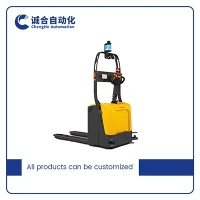
As a supplier of Heavy Duty AGVs, I've witnessed firsthand the transformative impact these robust machines have on industrial logistics. One of the most critical aspects of their operation is how they communicate with other AGVs within a fleet. In this blog, I'll delve into the various communication methods and technologies involved, highlighting their significance in ensuring efficient and safe fleet management.
The Importance of AGV Communication
In a dynamic industrial environment, a fleet of Heavy Duty AGVs needs to work in harmony to achieve optimal productivity. Effective communication between AGVs is essential for several reasons:


- Collision Avoidance: Heavy Duty AGVs, such as the Heavy load Automated Guided Vehicle, often operate in confined spaces. By sharing real - time position and movement information, they can avoid collisions with each other and other obstacles in the workspace.
- Task Coordination: When multiple AGVs are assigned different tasks within a workflow, communication allows them to coordinate their actions. For example, one AGV may need to wait for another to complete loading or unloading operations before proceeding to the next step.
- Resource Optimization: Through communication, the fleet can optimize the use of resources such as charging stations, storage areas, and transportation routes. AGVs can share information about resource availability and make decisions accordingly.
Communication Methods
There are several communication methods that Heavy Duty AGVs can use to interact with each other in a fleet:
Wired Communication
Wired communication, although not as commonly used in modern AGV fleets due to its limitations, still has some applications. Ethernet cables can be used to establish a direct connection between AGVs. This method offers high - speed and reliable data transfer. However, it restricts the mobility of the AGVs as they need to be physically connected. In some fixed - route applications, where the AGVs operate in a relatively static environment, wired communication can be a viable option.
Wireless Communication
- Wi - Fi: Wi - Fi is a widely used wireless communication technology in AGV fleets. It provides high - speed data transfer and a relatively large coverage area. AGVs can connect to a local Wi - Fi network, allowing them to communicate with each other and with a central control system. The central control system can then manage the fleet, assign tasks, and monitor the status of each AGV. However, Wi - Fi signals can be affected by interference from other electronic devices and physical obstacles, which may lead to communication disruptions.
- ZigBee: ZigBee is a low - power, wireless communication protocol designed for short - range communication. It is suitable for AGV fleets where the AGVs need to communicate in close proximity. ZigBee networks are self - organizing, which means that AGVs can easily join or leave the network without complex configuration. The low power consumption of ZigBee also makes it an energy - efficient option for AGV communication.
- Bluetooth: Bluetooth technology can also be used for AGV communication, especially for short - range and low - data - rate communication. It is commonly used for pairing AGVs with other devices such as handheld controllers or sensors. Bluetooth has the advantage of being widely available and easy to implement. However, its range is relatively limited compared to Wi - Fi and ZigBee.
Data Sharing and Protocols
In addition to the communication methods, AGVs need to follow specific data sharing protocols to ensure effective communication. One of the common protocols used in AGV fleets is the Modbus protocol. Modbus is an open - standard communication protocol that allows devices to exchange data over a wired or wireless network. It defines a set of rules for data transmission, including how data is formatted, addressed, and read or written.
Another important aspect of data sharing is the type of information that AGVs exchange. This typically includes:
- Position and Movement Information: AGVs need to share their current position, speed, and direction of movement. This information is crucial for collision avoidance and task coordination. For example, if one AGV detects that another AGV is approaching its path, it can adjust its speed or change its route to avoid a collision.
- Task Status: AGVs share information about the status of their assigned tasks, such as whether they are loading, unloading, or in transit. This allows the fleet to coordinate the overall workflow and ensure that tasks are completed in a timely manner.
- Battery Status: Since Heavy Duty AGVs rely on batteries for power, sharing battery status information is essential. Other AGVs and the central control system can use this information to plan charging schedules and optimize the use of available charging stations.
Centralized vs. Decentralized Communication
There are two main approaches to AGV communication within a fleet: centralized and decentralized.
Centralized Communication
In a centralized communication system, there is a central control server that acts as the hub of all communication. All AGVs in the fleet send their data to the central server, which then processes the information and makes decisions regarding task assignment, route planning, and collision avoidance. The central server can also communicate with external systems, such as inventory management systems or production control systems. The advantage of a centralized system is that it provides a comprehensive overview of the entire fleet, allowing for efficient and coordinated management. However, it also has a single - point - of - failure risk, as any disruption to the central server can affect the operation of the entire fleet.
Decentralized Communication
In a decentralized communication system, AGVs communicate directly with each other without relying on a central server. Each AGV has its own intelligence and can make decisions based on the information received from other AGVs. Decentralized systems are more resilient to failures, as there is no single - point - of - failure. However, they require more sophisticated algorithms and protocols to ensure that the AGVs can coordinate effectively without a central authority.
Real - World Applications and Case Studies
Let's take a look at some real - world applications of how Heavy Duty AGVs communicate with each other in a fleet. In a large - scale manufacturing plant, a fleet of Ultra - long Automated Guided Cart is used to transport raw materials and finished products between different production areas. These AGVs communicate with each other using Wi - Fi and a centralized control system. The central control system assigns tasks to each AGV, monitors their positions in real - time, and coordinates their movements to avoid collisions. This setup has significantly improved the efficiency of material transportation in the plant, reducing manual labor and minimizing downtime.
In another example, a logistics warehouse uses a fleet of Heavy Duty Automatic Transfer Cart for storing and retrieving goods from the storage racks. The AGVs communicate using ZigBee in a decentralized manner. Each AGV can sense the presence of other AGVs in its vicinity and adjust its movement accordingly. This has led to a more flexible and scalable operation, as new AGVs can be easily added to the fleet without the need for extensive reconfiguration.
Conclusion and Call to Action
Effective communication between Heavy Duty AGVs in a fleet is crucial for achieving optimal productivity, safety, and resource utilization in industrial environments. By understanding the different communication methods, data sharing protocols, and approaches (centralized vs. decentralized), businesses can design and implement AGV fleets that meet their specific needs.
If you are interested in learning more about how our Heavy Duty AGVs communicate with each other in a fleet or are considering purchasing AGVs for your business, we encourage you to reach out to us. Our team of experts is ready to discuss your requirements and provide you with customized solutions. Contact us for procurement and let's start optimizing your industrial logistics together!
References
- "Automated Guided Vehicles: Technology, Implementation, and Management" by Peter R. Kingsley
- "Industrial Communication Networks: Technology, Standards, and Applications" by Hermann Blume and Paul Falco