Hey there! As a supplier of Counterweight Forklift AGVs, I often get asked about how these nifty machines navigate in a warehouse. It's a fascinating topic, and I'm excited to share all the details with you.
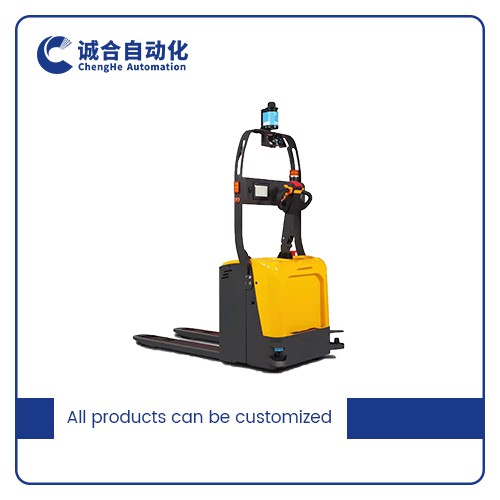
First off, let's talk about what a Counterweight Forklift AGV is. It's an automated guided vehicle with a counterweight design, which is used for lifting and moving heavy loads in a warehouse setting. These AGVs are super handy as they can work around the clock without getting tired, increasing efficiency and reducing the risk of human error.
So, how do they navigate? Well, there are several methods, and each has its own advantages.
Laser Navigation
One of the most common navigation methods for Counterweight Forklift AGVs is laser navigation. These AGVs are equipped with a laser scanner on top. The scanner emits laser beams in all directions and measures the distance to the surrounding objects by analyzing the reflected light.
In a warehouse, reflectors are placed on the walls or other fixed structures. The AGV's laser scanner detects these reflectors and uses them as reference points to calculate its position. It creates a map of the warehouse based on these reflector positions and then uses this map to plan its path.
For example, if the AGV needs to pick up a pallet from a specific location and move it to another, it will use the map to determine the shortest and safest route. The laser scanner continuously updates the AGV's position as it moves, allowing it to adjust its path in real - time if there are any obstacles in the way.
Vision Navigation
Vision navigation is another popular option. AGVs with vision navigation systems have cameras installed on them. These cameras capture images of the warehouse environment.
The AGV's software then analyzes these images to identify landmarks, such as signs, markings on the floor, or specific objects. By comparing the current images with a pre - stored map of the warehouse, the AGV can determine its position.
Vision navigation is great because it doesn't require the installation of additional infrastructure like reflectors. However, it can be affected by lighting conditions. For instance, if there are sudden changes in light, such as when a door is opened and sunlight floods in, it might cause the camera to have trouble accurately identifying landmarks.
Inertial Navigation
Inertial navigation uses sensors like accelerometers and gyroscopes. These sensors measure the AGV's acceleration and angular velocity. By integrating these measurements over time, the AGV can estimate its position and orientation.
Inertial navigation is often used in combination with other navigation methods. For example, in a situation where the laser or vision system temporarily loses its reference points, the inertial navigation system can keep track of the AGV's movement for a short period.
However, inertial navigation has its limitations. Over time, small errors in the sensor measurements can accumulate, leading to a significant deviation in the estimated position. That's why it's usually used as a supplementary method.

Magnetic Navigation
Magnetic navigation involves placing magnetic tapes or markers on the warehouse floor. The AGV has magnetic sensors that detect these magnetic fields.
The AGV follows the path defined by the magnetic tapes. It's a relatively simple and cost - effective method. But it lacks flexibility. If you need to change the AGV's route, you have to physically move or add magnetic tapes.
RFID Navigation
Radio - Frequency Identification (RFID) tags can also be used for navigation. These tags are placed at strategic locations in the warehouse, such as at the entrances of aisles or near storage racks.
The AGV has an RFID reader that can detect the tags as it passes by. By knowing the location of each tag, the AGV can determine its position and use this information to navigate.
RFID navigation is useful for providing precise location information at specific points. But similar to magnetic navigation, it requires the installation of tags, which can be time - consuming and costly.
Now, let's talk about how these navigation methods work together to ensure the smooth operation of our Counterweight Forklift AGVs.
In most cases, we use a combination of navigation methods. For example, we might use laser navigation as the primary method because it provides high - precision positioning. The vision system can then be used as a backup or to identify specific objects or areas in the warehouse.
The inertial navigation system helps to fill in the gaps when the primary navigation methods encounter problems, such as when the laser scanner loses sight of the reflectors due to an obstacle.
Our Counterweight Forklift AGVs are designed to be highly adaptable. They can switch between different navigation methods automatically based on the situation. For instance, if the laser navigation system is not working properly due to a malfunction in the reflector detection, the AGV can switch to vision or inertial navigation to continue its task.
We offer a range of Counterweight Forklift AGVs to meet different warehouse needs. If you're interested in an Automated AGV Pallet Stacker, it's a great option for stacking pallets up to 3 meters high. Our AGV Pallet Truck - 3T can handle heavy loads of up to 3 tons, and the Automated Counterbalanced Forklift is perfect for general material handling tasks with a load capacity of 1.5 tons.
If you're running a warehouse and looking to improve your material handling efficiency, our Counterweight Forklift AGVs are a great solution. They can save you time and money in the long run by reducing labor costs and minimizing the risk of accidents.
If you're interested in learning more about our products or have any questions about how our AGVs can fit into your warehouse operations, don't hesitate to get in touch. We're always happy to have a chat and discuss your specific requirements. Whether it's choosing the right navigation method or customizing an AGV for your unique needs, we're here to help.
References
- "Automated Guided Vehicle Systems" by David A. Vorster
- "Warehouse Automation: Technologies and Applications" by Robert M. Grosse