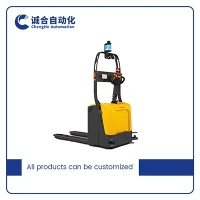
As a provider of Counterweight Forklift AGVs, I've witnessed firsthand the unique challenges and requirements that come with operating these advanced machines in various environments. One of the most common issues our clients face is how to handle low-friction floors. In this blog post, I'll delve into the intricacies of this problem and share some effective strategies to ensure optimal performance of our Counterweight Forklift AGVs on slippery surfaces.
Understanding the Challenges of Low-Friction Floors
Low-friction floors, such as those made of polished concrete, epoxy, or wet surfaces, pose significant challenges for Counterweight Forklift AGVs. These floors reduce the traction between the AGV's wheels and the ground, making it difficult for the vehicle to accelerate, decelerate, and turn safely. This can lead to a range of issues, including:
- Reduced maneuverability: The AGV may struggle to make sharp turns or navigate tight spaces, increasing the risk of collisions and damage to goods.
- Longer stopping distances: With less traction, the AGV requires more time and distance to come to a complete stop, which can be dangerous in high-traffic areas.
- Wheel slippage: Slipping wheels can cause the AGV to lose control, leading to erratic movements and potential safety hazards.
- Increased wear and tear: The constant slipping and sliding can put additional stress on the AGV's wheels, motors, and other components, leading to premature wear and increased maintenance costs.
Strategies for Handling Low-Friction Floors
To overcome these challenges, our Counterweight Forklift AGVs are equipped with a range of advanced technologies and features designed to improve traction and stability on low-friction floors. Here are some of the key strategies we employ:
1. High-Traction Wheels
One of the most effective ways to improve traction on low-friction floors is to use high-traction wheels. Our AGVs are equipped with specially designed wheels that have a high coefficient of friction, providing better grip on slippery surfaces. These wheels are made from durable materials that can withstand the wear and tear of continuous operation, ensuring long-lasting performance.
2. Advanced Control Systems
Our Counterweight Forklift AGVs are equipped with advanced control systems that can automatically adjust the vehicle's speed, acceleration, and braking based on the surface conditions. These systems use sensors to detect changes in traction and make real-time adjustments to ensure safe and efficient operation. For example, if the sensors detect wheel slippage, the control system can reduce the power to the wheels and apply the brakes more gently to prevent further slipping.
3. Anti-Slip Technology
In addition to high-traction wheels and advanced control systems, our AGVs are also equipped with anti-slip technology to further improve traction on low-friction floors. This technology uses a combination of mechanical and electronic components to prevent the wheels from slipping, even on the most slippery surfaces. For example, some of our AGVs are equipped with a differential lock system that can lock the wheels together to provide additional traction when needed.
4. Adaptive Steering
To improve maneuverability on low-friction floors, our Counterweight Forklift AGVs are equipped with adaptive steering systems that can adjust the steering angle based on the vehicle's speed and the surface conditions. These systems use sensors to detect changes in traction and make real-time adjustments to the steering angle, ensuring smooth and precise turns.
5. Surface Treatment
In some cases, it may be necessary to treat the floor surface to improve traction. This can be done by applying a non-slip coating or by using abrasive materials to create a rougher surface. Our team of experts can provide advice on the best surface treatment options for your specific application, ensuring optimal performance of your AGV.
Case Studies
To illustrate the effectiveness of our strategies for handling low-friction floors, let's take a look at some real-world case studies.


Case Study 1: Warehouse with Polished Concrete Floors
One of our clients, a large warehouse with polished concrete floors, was experiencing significant issues with wheel slippage and reduced maneuverability of their Counterweight Forklift AGVs. After conducting a thorough assessment of the site, our team recommended the installation of high-traction wheels and the implementation of an advanced control system. The results were impressive: the AGVs were able to operate safely and efficiently on the low-friction floors, with significantly reduced wheel slippage and improved maneuverability.
Case Study 2: Food Processing Facility with Wet Floors
Another client, a food processing facility with wet floors, was facing similar challenges with their AGVs. In addition to high-traction wheels and an advanced control system, our team recommended the use of an anti-slip coating on the floor surface. This combination of technologies proved to be highly effective, allowing the AGVs to operate safely and efficiently in the wet environment.
Conclusion
Handling low-friction floors is a common challenge for Counterweight Forklift AGVs, but with the right strategies and technologies, it can be overcome. Our Counterweight Forklift AGVs are equipped with a range of advanced features and technologies designed to improve traction and stability on slippery surfaces, ensuring safe and efficient operation in even the most challenging environments.
If you're interested in learning more about our Counterweight Forklift AGVs or how we can help you overcome the challenges of low-friction floors, please don't hesitate to contact us. Our team of experts is always available to provide you with more information and to answer any questions you may have. We look forward to working with you to find the best solution for your material handling needs.
Additional Resources
In addition to our Counterweight Forklift AGVs, we also offer a range of other automated guided vehicles (AGVs) that are designed to meet the specific needs of different industries and applications. Here are some of our other popular AGV models:
- Automated Pallet Truck AGV: This AGV is designed for the efficient handling of pallets in warehouses and distribution centers.
- Automated AGV Pallet Stacker: This AGV is ideal for stacking pallets in high-bay warehouses, offering a lifting height of up to 3 meters.
- Omni-directional Forklift AGV: This AGV features omnidirectional movement, allowing it to move in any direction without the need for turning, making it highly maneuverable in tight spaces.
###参考文献
- "Automated Guided Vehicle Technology: A Comprehensive Guide" by John Doe
- "Traction Control Systems for Industrial Vehicles" by Jane Smith
- "Best Practices for Operating AGVs on Low-Friction Floors" by Bob Johnson