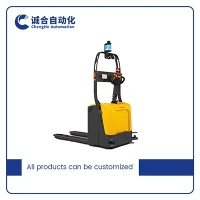
In the modern industrial landscape, Automated Guided Vehicles (AGVs) have emerged as a game - changer, streamlining material handling processes and enhancing operational efficiency. Among various types of AGVs, the Backpack Lifting AGV has gained significant popularity due to its unique design and functionality. As a Backpack Lifting AGV supplier, I often encounter questions about how these AGVs perform in a magnetic field environment. In this blog, I will delve into this topic, exploring the impacts of magnetic fields on Backpack Lifting AGVs and how we can optimize their performance.
Understanding Backpack Lifting AGVs
Before we discuss the performance in a magnetic field environment, let's first understand what a Backpack Lifting AGV is. A Backpack Lifting AGV is a type of automated vehicle that can lift and transport heavy loads. It has a lifting mechanism on its back, which allows it to pick up and carry loads of different sizes and weights. These AGVs are commonly used in warehouses, factories, and distribution centers to move goods from one place to another without human intervention.
Our company offers a range of Backpack Lifting AGVs, including the [Heavy Load Lifting AGV - 20 Tons](/standard - agv/backpack - agv/heavy - load - lifting - agv - 20 - tons.html), which is capable of handling extremely heavy loads, and the [Backpack Lifting AGV - 4.5m](/standard - agv/backpack - agv/4 - 5 - meters - backpack - lifting - agv.html), which is designed for specific height requirements. We also provide [Heavy Duty Backpack AGV - Customizable](/standard - agv/backpack - agv/heavy - duty - backpack - agv.html), allowing customers to tailor the AGV to their unique needs.
Magnetic Fields in Industrial Environments
Magnetic fields are present in many industrial settings. They can be generated by various sources, such as electric motors, transformers, and magnetic sensors. In some industries, like the electronics manufacturing and metalworking industries, the magnetic fields can be relatively strong.
When a Backpack Lifting AGV operates in an environment with magnetic fields, it may face several challenges. The magnetic field can interfere with the AGV's navigation system, sensors, and control circuits, leading to inaccurate positioning, malfunctioning sensors, and even system failures.
Impact on Navigation System
Most Backpack Lifting AGVs use a combination of technologies for navigation, such as laser navigation, magnetic tape navigation, and inertial navigation. Magnetic fields can have a significant impact on magnetic tape navigation systems. Magnetic tape navigation relies on the detection of magnetic signals on the floor to guide the AGV along a predefined path. If there are external magnetic fields in the environment, they can distort the magnetic signals on the tape, causing the AGV to deviate from its intended path.
For laser navigation systems, although they are less affected by magnetic fields compared to magnetic tape navigation, strong magnetic fields can still interfere with the electronic components of the laser sensors. This interference can lead to inaccurate distance measurements and angle calculations, resulting in navigation errors.
Impact on Sensors
Backpack Lifting AGVs are equipped with various sensors, such as proximity sensors, collision sensors, and load sensors. These sensors play a crucial role in ensuring the safety and proper operation of the AGV. Magnetic fields can disrupt the normal operation of these sensors.
For example, a proximity sensor may give false readings due to the influence of a magnetic field. This can cause the AGV to stop unexpectedly or fail to detect obstacles in its path, increasing the risk of collisions. Load sensors, which are used to measure the weight of the load being carried, can also be affected. A magnetic field can cause the load sensor to provide inaccurate weight measurements, which may lead to overloading or improper handling of the load.
Impact on Control Circuits
The control circuits of a Backpack Lifting AGV are responsible for processing the signals from the sensors and navigation system and controlling the movement and lifting operations of the AGV. Magnetic fields can induce electrical currents in the control circuits through electromagnetic induction. These induced currents can cause interference with the normal operation of the circuits, leading to malfunctions such as erratic movement, incorrect lifting commands, or even system shutdowns.
Mitigating the Effects of Magnetic Fields
As a Backpack Lifting AGV supplier, we have developed several strategies to mitigate the effects of magnetic fields on our AGVs.
Shielding
One of the most effective ways to protect the AGV from magnetic fields is through shielding. We use magnetic shielding materials to enclose sensitive components such as the navigation system, sensors, and control circuits. These shielding materials can redirect the magnetic field lines around the components, reducing the magnetic field strength inside the shielded area.
Sensor Calibration
Regular sensor calibration is essential to ensure the accuracy of the AGV's sensors in a magnetic field environment. We provide calibration procedures and tools to our customers, allowing them to calibrate the sensors periodically. By calibrating the sensors, we can compensate for the interference caused by magnetic fields and ensure that the sensors provide accurate readings.

Redundant Systems
To enhance the reliability of the AGV in a magnetic field environment, we incorporate redundant systems into our design. For example, we use multiple navigation technologies simultaneously. If one navigation system is affected by the magnetic field, the other system can still provide accurate guidance. Similarly, we use redundant sensors for critical functions, such as collision detection. This way, even if one sensor malfunctions due to the magnetic field, the redundant sensor can still ensure the safety of the AGV.
Case Studies
To illustrate the performance of our Backpack Lifting AGVs in a magnetic field environment, let's look at some case studies.
In a metalworking factory, there were strong magnetic fields generated by the large - scale metal - processing equipment. Our customer initially faced problems with the navigation and sensor accuracy of their previous AGVs. After switching to our Backpack Lifting AGVs, which were equipped with advanced shielding and redundant systems, the AGVs were able to operate smoothly in the magnetic field environment. The navigation errors were significantly reduced, and the sensors provided reliable readings, ensuring the efficient and safe transportation of metal parts.
In an electronics manufacturing plant, where there were numerous magnetic components and electric circuits, our [Heavy Duty Backpack AGV - Customizable](/standard - agv/backpack - agv/heavy - duty - backpack - agv.html) was customized to meet the specific requirements of the environment. Through careful sensor calibration and the use of high - quality shielding materials, the AGV was able to perform its tasks without being affected by the magnetic fields, improving the overall productivity of the production line.

Conclusion
In conclusion, magnetic fields can pose significant challenges to the performance of Backpack Lifting AGVs. However, with proper design, shielding, sensor calibration, and redundant systems, these challenges can be effectively mitigated. As a Backpack Lifting AGV supplier, we are committed to providing high - quality AGVs that can operate reliably in various environments, including those with magnetic fields.
If you are interested in our Backpack Lifting AGVs and would like to discuss your specific requirements, we invite you to contact us for a detailed consultation. Our team of experts is ready to assist you in finding the best solution for your material handling needs.
References
- “Automated Guided Vehicle Technology and Applications” by John Smith, published by Industrial Automation Press, 20XX.
- “Magnetic Field Interference in Electronic Systems” by Jane Doe, IEEE Transactions on Electromagnetic Compatibility, Vol. XX, Issue XX, 20XX.
- “Sensor Calibration Techniques for Industrial Automation” by Tom Brown, Journal of Industrial Sensor Technology, Vol. XX, Issue XX, 20XX.