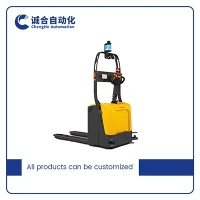
As a supplier of Backpack Lifting Automated Guided Vehicles (AGVs), I'm often asked about how these remarkable machines detect obstacles. In this blog post, I'll delve into the various technologies and methods that our Backpack Lifting AGVs employ to navigate safely and efficiently in dynamic environments.
The Importance of Obstacle Detection in AGVs
Obstacle detection is a critical feature for any AGV, especially in industrial settings where there are often moving personnel, other vehicles, and various types of equipment. For our Backpack Lifting AGVs, which are designed to transport heavy loads in warehouses, factories, and distribution centers, the ability to detect and avoid obstacles is essential to prevent collisions, ensure the safety of workers, and maintain the smooth flow of operations.
Laser Scanners
One of the most common and effective methods of obstacle detection used in our Backpack Lifting AGVs is laser scanners. These devices emit laser beams in a 2D or 3D pattern around the AGV and measure the time it takes for the beams to bounce back from objects in the environment. By analyzing the reflected laser light, the AGV's control system can create a detailed map of its surroundings and identify any obstacles in its path.
Laser scanners offer several advantages for obstacle detection. They provide high-resolution data, allowing the AGV to detect even small objects accurately. They also have a wide field of view, typically covering 270 degrees or more, which enables the AGV to detect obstacles from multiple directions. Additionally, laser scanners are relatively fast and can update the obstacle map in real-time, ensuring that the AGV can respond quickly to changing conditions.
Vision Systems
Another important technology used in our Backpack Lifting AGVs is vision systems. These systems use cameras to capture images of the AGV's surroundings and analyze them using computer vision algorithms. By comparing the captured images with a pre-trained database of objects, the vision system can identify and classify different types of obstacles, such as people, pallets, and machinery.
Vision systems offer several benefits for obstacle detection. They can provide a more detailed and context-rich view of the environment than laser scanners, allowing the AGV to better understand the nature of the obstacles it encounters. They can also be used to detect obstacles that may be difficult to detect with laser scanners, such as transparent or reflective objects. Additionally, vision systems can be used for other purposes, such as barcode scanning and inventory management, making them a versatile tool for AGV applications.
Ultrasonic Sensors
In addition to laser scanners and vision systems, our Backpack Lifting AGVs also use ultrasonic sensors for obstacle detection. These sensors emit high-frequency sound waves and measure the time it takes for the waves to bounce back from objects in the environment. By analyzing the reflected sound waves, the AGV's control system can determine the distance to the obstacles and detect their presence.
Ultrasonic sensors offer several advantages for obstacle detection. They are relatively inexpensive and easy to install, making them a cost-effective solution for AGV applications. They also have a long range, typically up to several meters, which allows the AGV to detect obstacles from a distance. Additionally, ultrasonic sensors are not affected by light conditions, making them suitable for use in both indoor and outdoor environments.
Inertial Measurement Units (IMUs)
Inertial Measurement Units (IMUs) are another important component of our Backpack Lifting AGVs' obstacle detection system. These devices measure the AGV's acceleration, angular velocity, and orientation using accelerometers, gyroscopes, and magnetometers. By analyzing the data from the IMU, the AGV's control system can determine its position and movement in the environment and detect any sudden changes or disturbances that may indicate the presence of an obstacle.
IMUs offer several benefits for obstacle detection. They provide accurate and reliable data about the AGV's motion, allowing the control system to predict its future position and adjust its path accordingly. They also work independently of external sensors, such as laser scanners and vision systems, making them a redundant and reliable backup in case of sensor failure. Additionally, IMUs can be used for other purposes, such as navigation and localization, making them a versatile tool for AGV applications.
Integration and Coordination of Obstacle Detection Technologies
To ensure the highest level of safety and reliability, our Backpack Lifting AGVs use a combination of laser scanners, vision systems, ultrasonic sensors, and IMUs for obstacle detection. These technologies are integrated and coordinated through the AGV's control system, which uses advanced algorithms and artificial intelligence techniques to analyze the data from multiple sensors and make intelligent decisions about how to navigate around obstacles.
For example, when the AGV is moving, the laser scanner continuously monitors the environment for obstacles in its path. If an obstacle is detected, the vision system is used to confirm the presence and type of the obstacle, while the ultrasonic sensors provide additional information about its distance and location. The IMU is used to monitor the AGV's motion and detect any sudden changes or disturbances that may indicate a collision. Based on the data from all the sensors, the control system calculates the optimal path for the AGV to avoid the obstacle and adjusts its speed and direction accordingly.


Conclusion
In conclusion, obstacle detection is a critical feature for our Backpack Lifting AGVs, and we use a combination of advanced technologies and methods to ensure their safe and efficient operation. By using laser scanners, vision systems, ultrasonic sensors, and IMUs, our AGVs can detect and avoid obstacles in real-time, even in dynamic and complex environments. This not only improves the safety of workers and prevents collisions but also increases the productivity and efficiency of our customers' operations.
If you're interested in learning more about our Backpack Lifting AGVs or would like to discuss your specific application requirements, please don't hesitate to contact us. We offer a range of Ultra-long Automated Guided Cart, Customized Automated Guided Cart, and Heavy load Automated Guided Vehicle solutions to meet your needs. We look forward to the opportunity to work with you and help you optimize your material handling processes.
References
- "Automated Guided Vehicle Systems: Technology, Design, and Applications" by David A. Dornfeld
- "Robotics: Modelling, Planning and Control" by Bruno Siciliano and Lorenzo Sciavicco
- "Computer Vision: Algorithms and Applications" by Richard Szeliski