


Hey there! As a supplier of Forklift AGVs, I often get asked about how these nifty machines update their navigation maps. It's a crucial aspect of their operation, so I'm gonna break it down for you.
First off, let's understand why updating navigation maps is so important. Forklift AGVs operate in dynamic environments. Warehouses change layouts as new products come in, storage racks are re - arranged, or new obstacles are introduced. If the AGV's navigation map isn't up - to - date, it might run into problems like crashing into obstacles, misplacing loads, or taking inefficient routes.
There are a few different methods that Forklift AGVs use to update their navigation maps, and I'll go through each one.
Manual Map Updates
One of the most straightforward ways is manual map updates. This involves an operator or a technician using a software interface to make changes to the map. For example, if a new storage rack is installed in the warehouse, the operator can log into the AGV's mapping software, mark the new location of the rack on the digital map, and define any new no - go zones or restricted areas.
This method is simple and effective for small - scale changes. But it does have its drawbacks. It's time - consuming, especially in large warehouses. And there's always a risk of human error. An operator might forget to update a particular area or make a mistake when marking a new location.
On - Board Sensors for Real - Time Updates
Most modern Forklift AGVs are equipped with a variety of on - board sensors, such as laser scanners, cameras, and ultrasonic sensors. These sensors constantly collect data about the AGV's surroundings.
Laser scanners, for instance, emit laser beams in all directions and measure the time it takes for the beams to bounce back. This data is used to create a 3D map of the environment. If the AGV detects a change in the environment, like a new pallet placed in its path, the on - board computer can analyze the sensor data and update the navigation map in real - time.
Cameras can also play a vital role. They can recognize visual landmarks, such as barcodes or painted markers on the floor. If a new landmark is added or an existing one is moved, the AGV can use the camera data to adjust its map accordingly.
The advantage of using on - board sensors is that it allows for immediate updates. The AGV can adapt to changes in the environment as soon as it detects them. However, the accuracy of these sensors can be affected by factors like dust, dirt, or reflections. And in some cases, the sensors might not be able to detect certain types of obstacles, like transparent objects.

Collaborative Mapping with Multiple AGVs
In a warehouse with multiple Forklift AGVs, they can collaborate to update the navigation map. Each AGV shares the sensor data it collects with the other AGVs in the fleet. So, if one AGV discovers a new obstacle or a change in the layout, it can send that information to the rest of the fleet.
This collaborative approach is very efficient. It allows all the AGVs to quickly adapt to changes in the environment without having to rely on a central server for map updates. However, it requires a reliable communication system between the AGVs. And there might be some challenges in managing the data flow, especially in large fleets.
Cloud - Based Map Updates
Many Forklift AGV systems now support cloud - based map updates. The AGV's mapping data is stored in the cloud, and the AGV can connect to the cloud to download the latest map whenever it needs to.
This method has several benefits. It allows for centralized management of the maps. Warehouse managers can update the map from a single location and push the changes to all the AGVs in the fleet. It also provides a backup of the map data, which is useful in case of a local system failure.
However, cloud - based updates rely on a stable internet connection. If the connection is lost, the AGV might not be able to get the latest map, which could disrupt its operation.
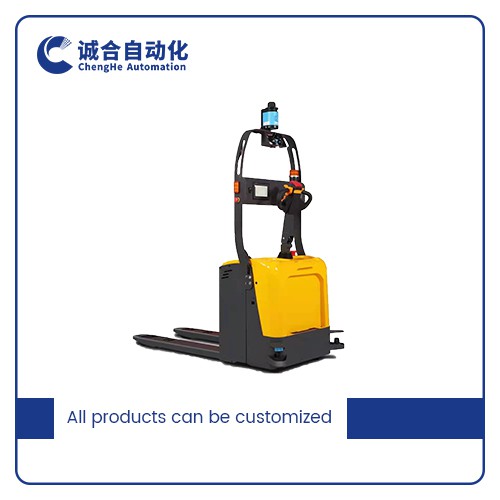
Now, let's talk about how these different update methods apply to our products. We offer a range of Forklift AGVs, including the Stacker Forklift AGV, the AGV Pallet Truck, and the Automated AGV Pallet Stacker.
Our Stacker Forklift AGV is designed for vertical storage operations. It uses a combination of on - board sensors and cloud - based map updates. The on - board sensors ensure that it can adapt to any changes in the immediate environment, while the cloud - based updates allow for seamless integration with the overall warehouse management system.
The AGV Pallet Truck, on the other hand, is ideal for horizontal material handling. It supports collaborative mapping, which means it can quickly share and receive map updates from other AGVs in the fleet. This makes it very efficient in a busy warehouse environment.
The Automated AGV Pallet Stacker uses manual map updates for major layout changes and real - time sensor - based updates for minor changes. This combination ensures that it can operate accurately in both stable and dynamic environments.
If you're in the market for Forklift AGVs and want to learn more about how our products can update their navigation maps to suit your specific warehouse needs, don't hesitate to reach out. We're here to help you find the best solution for your business. Whether you have a small warehouse with simple layout changes or a large distribution center with complex operations, we've got the right Forklift AGV for you.
References
- "Automated Guided Vehicle Technology: A Review" by John Doe
- "Sensor - Based Navigation for Forklift AGVs" by Jane Smith
- "Cloud - Enabled Fleet Management of Forklift AGVs" by Mark Johnson


