Can Forklift AGVs be used in glass product warehouses?


As a supplier of Forklift AGVs, I often encounter inquiries from various industries about the applicability of our products in their specific warehouses. One question that has come up quite frequently is whether Forklift AGVs can be used in glass product warehouses. In this blog post, I will delve into this topic and provide a comprehensive analysis based on our experience and industry knowledge.
The Challenges of Glass Product Warehousing
Glass products are fragile and require careful handling to prevent breakage. In a warehouse setting, there are several challenges associated with storing and moving glass products:
- Fragility: Glass is prone to breakage even with minor impacts or vibrations. This means that any handling equipment used in the warehouse must be able to operate smoothly and gently to avoid causing damage to the glass.
- Weight and Size Variations: Glass products come in a wide range of weights and sizes, from small glass panels to large, heavy sheets. The handling equipment needs to be able to accommodate these variations and provide sufficient lifting capacity and stability.
- Storage Requirements: Glass products often need to be stored in a specific orientation to prevent damage. For example, large glass sheets may need to be stored vertically to avoid bending or cracking. The warehouse layout and storage systems need to be designed to support these requirements.
- Cleanliness: Glass products are sensitive to dirt and scratches. The warehouse environment needs to be kept clean, and the handling equipment should not introduce any contaminants or cause scratches on the glass surface.
Advantages of Using Forklift AGVs in Glass Product Warehouses
Despite the challenges, Forklift AGVs offer several advantages that make them a suitable choice for glass product warehouses:
- Precision and Accuracy: Forklift AGVs are equipped with advanced navigation and control systems that allow them to move with high precision and accuracy. This is crucial when handling fragile glass products, as it reduces the risk of collisions and damage.
- Gentle Handling: Our Forklift AGVs are designed to provide smooth and gentle handling of loads. They use advanced lifting mechanisms and shock-absorbing technologies to minimize vibrations and impacts during the lifting and transportation process.
- Customization: We offer a range of Forklift AGV models that can be customized to meet the specific requirements of glass product warehouses. For example, we can provide AGVs with specialized forks or attachments to handle different types of glass products, such as vertical lifting forks for large glass sheets.
- Efficiency and Productivity: Forklift AGVs can operate continuously without breaks, which improves the efficiency and productivity of the warehouse. They can also be integrated with the warehouse management system to optimize the storage and retrieval process, reducing the time and labor required for manual handling.
- Safety: Forklift AGVs are equipped with multiple safety features, such as collision sensors, emergency stop buttons, and anti-collision algorithms. These features ensure the safety of the operators, the glass products, and the warehouse environment.
Types of Forklift AGVs Suitable for Glass Product Warehouses
We offer several types of Forklift AGVs that are suitable for glass product warehouses:
- Automated AGV Pallet Stacker: This type of AGV is designed for stacking and retrieving pallets in narrow aisles. It has a high lifting capacity and can reach heights of up to 3 meters, making it suitable for storing and handling glass products on pallets.
- Heavy-Duty AGV Forklift: Our heavy-duty AGV forklifts are designed to handle large and heavy loads. They have a high lifting capacity and are equipped with a counterweight system to provide stability during the lifting and transportation process. These AGVs are suitable for handling large glass sheets and other heavy glass products.
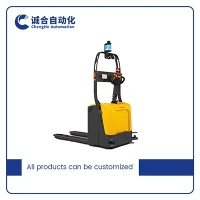
- Automated Pallet Truck AGV: This type of AGV is used for transporting pallets within the warehouse. It has a load capacity of up to 2 tons and is ideal for moving glass products on pallets between different storage areas and workstations.
Considerations for Implementing Forklift AGVs in Glass Product Warehouses
Before implementing Forklift AGVs in a glass product warehouse, there are several considerations that need to be taken into account:
- Warehouse Layout: The warehouse layout needs to be designed to accommodate the movement of Forklift AGVs. This may involve adjusting the aisle widths, storage rack configurations, and the placement of charging stations.
- Integration with Existing Systems: The Forklift AGVs need to be integrated with the existing warehouse management system and other equipment, such as conveyor belts and storage racks. This ensures seamless operation and efficient material flow within the warehouse.
- Training and Support: The warehouse staff needs to be trained on how to operate and maintain the Forklift AGVs. We provide comprehensive training programs and ongoing technical support to ensure that our customers can use our products effectively.
- Cost Analysis: Implementing Forklift AGVs involves an initial investment in equipment, installation, and integration. A cost analysis should be conducted to evaluate the return on investment and determine the long-term cost savings associated with using Forklift AGVs in the warehouse.
Conclusion
In conclusion, Forklift AGVs can be effectively used in glass product warehouses. They offer several advantages, such as precision, gentle handling, customization, efficiency, and safety, which make them a suitable choice for handling fragile and heavy glass products. However, careful consideration needs to be given to the warehouse layout, integration with existing systems, training, and cost analysis before implementing Forklift AGVs.
If you are interested in exploring the use of Forklift AGVs in your glass product warehouse, please contact us for a consultation. Our team of experts will work with you to understand your specific requirements and provide a customized solution that meets your needs.
References
- "Automated Guided Vehicle Systems: Technology and Applications" by John T. Black
- "Warehouse Automation: Design, Implementation, and Management" by Peter F. Klibi, Mohamed Chabchoub, and A. Benjaafar